

'%3e%3cpath%20d='M8%200C12.4183%200%2016%203.58172%2016%208C16%2012.4183%2012.4183%2016%208%2016C3.58172%2016%200%2012.4183%200%208C0%203.58172%203.58172%200%208%200ZM11.6162%204.38379C11.2257%203.99337%2010.5927%203.99338%2010.2021%204.38379L8%206.58594L5.79785%204.38379C5.40732%203.99334%204.77429%203.99329%204.38379%204.38379C3.99331%204.77429%203.99335%205.40733%204.38379%205.79785L6.58594%208L4.38379%2010.2021C3.99348%2010.5927%203.99341%2011.2257%204.38379%2011.6162C4.77426%2012.0066%205.40734%2012.0065%205.79785%2011.6162L8%209.41406L10.2021%2011.6162C10.5927%2012.0066%2011.2257%2012.0067%2011.6162%2011.6162C12.0067%2011.2257%2012.0066%2010.5927%2011.6162%2010.2021L9.41406%208L11.6162%205.79785C12.0066%205.40735%2012.0066%204.77429%2011.6162%204.38379Z'%20fill='%23080E17'%20fill-opacity='0.46'/%3e%3c/g%3e%3cdefs%3e%3cclipPath%20id='clip0_3761_713'%3e%3crect%20width='16'%20height='16'%20fill='white'/%3e%3c/clipPath%3e%3c/defs%3e%3c/svg%3e)



'%3e%3cpath%20fill-rule='evenodd'%20clip-rule='evenodd'%20d='M21.4999%2010.9993C21.4999%205.20009%2016.7986%200.498901%2010.9993%200.498901C5.19994%200.498901%200.498657%205.20009%200.498657%2010.9993C0.498657%2016.2404%204.33858%2020.5844%209.35855%2021.3722V14.0346H6.69238V10.9993H9.35855V8.68594C9.35855%206.05427%2010.9262%204.60062%2013.3248%204.60062C14.4736%204.60062%2015.6753%204.80571%2015.6753%204.80571V7.38979H14.3512C13.0468%207.38979%2012.64%208.19921%2012.64%209.0296V10.9993H15.5523L15.0867%2014.0346H12.64V21.3722C17.66%2020.5844%2021.4999%2016.2404%2021.4999%2010.9993Z'%20fill='%231568EA'/%3e%3c/g%3e%3c/svg%3e)


'%3e%3cpath%20d='M2.42045%2022.1876H6.31818V12.7217L0.75%208.54553V20.5171C0.75%2021.4414%201.49892%2022.1876%202.42045%2022.1876Z'%20fill='%234285F4'/%3e%3cpath%20d='M19.682%2022.1876H23.5797C24.5041%2022.1876%2025.2502%2021.4387%2025.2502%2020.5171V8.54553L19.682%2012.7217'%20fill='%2334A853'/%3e%3cpath%20d='M19.682%205.48293V12.7216L25.2502%208.54543V6.31816C25.2502%204.25236%2022.8921%203.07469%2021.2411%204.31361'%20fill='%23FBBC04'/%3e%3cpath%20d='M6.31824%2012.7217V5.48303L13.0001%2010.4944L19.6819%205.48303V12.7217L13.0001%2017.733'%20fill='%23EA4335'/%3e%3cpath%20d='M0.75%206.31816V8.54543L6.31818%2012.7216V5.48293L4.75909%204.31361C3.10534%203.07469%200.75%204.25236%200.75%206.31816Z'%20fill='%23C5221F'/%3e%3c/g%3e%3cdefs%3e%3cclipPath%20id='clip0_2954_7305'%3e%3crect%20width='24.5'%20height='18.375'%20fill='white'%20transform='translate(0.75%203.8125)'/%3e%3c/clipPath%3e%3c/defs%3e%3c/svg%3e)


DeepSeek V4 is DeepSeek’s latest large language model family—shipped as two MoE variants, DeepSeek V4-Pro and DeepSeek V4-Flash, both designed for native million-token context. If you are searching “DeepSeek V4,” you usually want the specs (parameters, context, license), how Pro differs from Flash, what the architecture changes buy you versus V3.x, and practical ways to run or call it. This guide focuses on the model itself first; a short note at the end covers one document-app path if you do not want to self-host.
Key Takeaways
V4-Pro (~1.6T total / ~49B activated) is the flagship for hard reasoning, large repos, and agent workflows.
V4-Flash (~284B total / ~13B activated) is the efficiency tier for lower latency and cost on everyday work.
Both target a 1M-token context window via hybrid compressed attention (CSA + HCA), cutting KV-cache pressure vs older stacks.
Weights are released under a permissive MIT license—confirm the file that ships with your checkpoint.
Access paths: official API/chat, open-weight download, or private serving—plus optional in-document helpers in apps like WPS.
What Is DeepSeek V4?
DeepSeek V4 is not a single chat persona—it is a two-tier model series from DeepSeek-AI. The preview lineup centers on Mixture-of-Experts (MoE) language models that keep a large total parameter pool but activate only a slice per token. That design is why V4 can chase frontier-style quality while still talking about inference efficiency.
In plain terms:
Total parameters describe the full expert pool sitting on disk / in the cluster.
Activated parameters are what run for each token—the number that drives most of the compute bill.
Context length is how much text (code, docs, chat history) the model can keep in one window. For V4, the headline figure is 1,000,000 tokens.
DeepSeek positions V4 as an upgrade path from the V3.x generation: stronger long-context efficiency, tighter reasoning/coding behavior, and open weights you can inspect or deploy under MIT terms. Exact public benchmarks shift as evals update—treat marketing leaderboards as directional, then validate on your own prompts and datasets.
DeepSeek V4-Pro vs DeepSeek V4-Flash
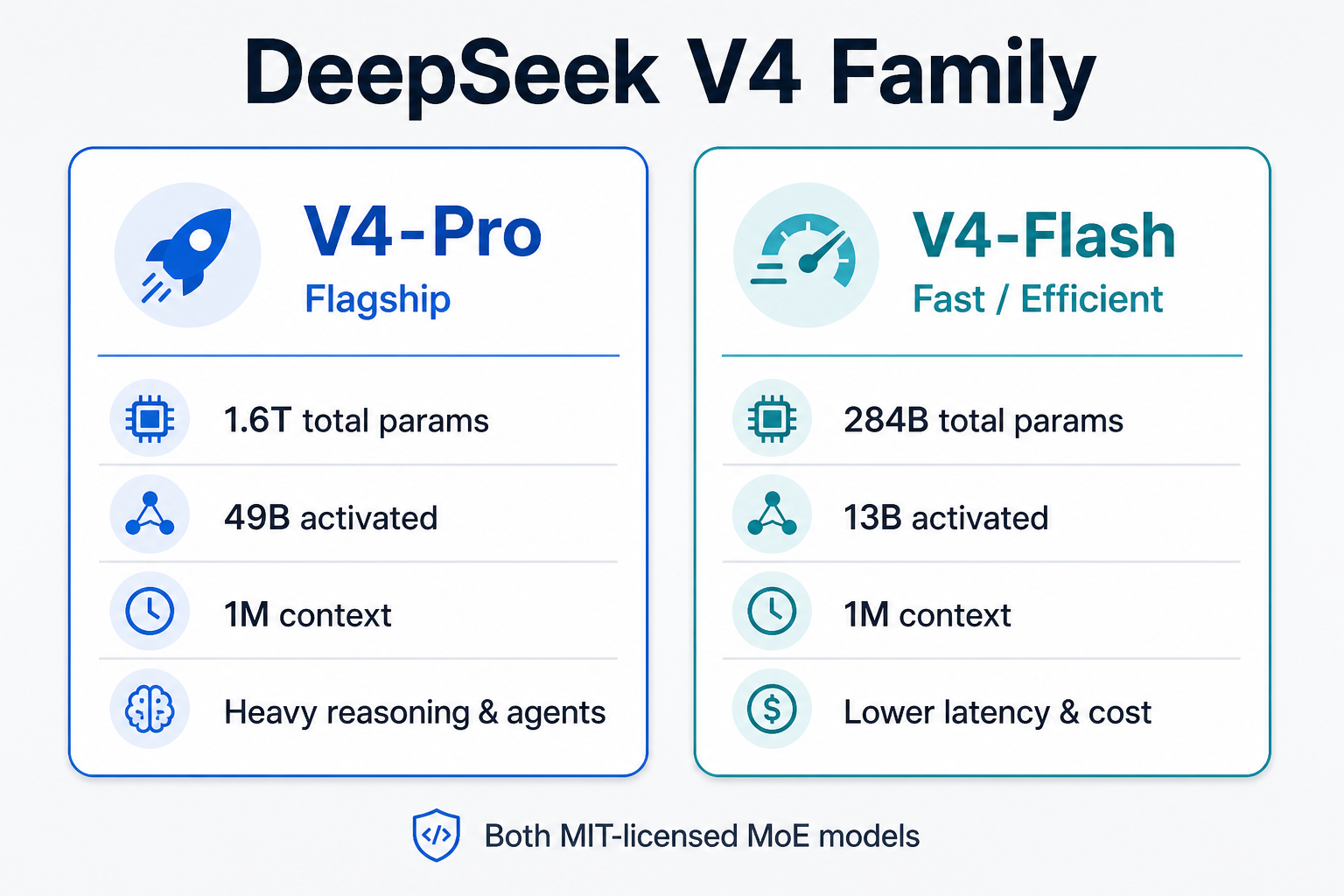
Pick the edition from workload shape, not from the cooler name:
| Spec | DeepSeek V4-Pro | DeepSeek V4-Flash |
|---|---|---|
| Role | Flagship / Expert-style work | Fast / Instant-style work |
| Total parameters | ~1.6 trillion (MoE) | ~284 billion (MoE) |
| Activated per token | ~49B | ~13B |
| Context window | 1,000,000 tokens | 1,000,000 tokens |
| Best for | Deep research, long financial/legal packs, large codebase agents, multi-step tooling | Daily chat, routine coding help, light automation, cost-sensitive high QPS |
| Trade-off | Higher quality ceiling; heavier to serve | Cheaper/faster; may lag Pro on the hardest tasks |
A practical rule: start on Flash for product chat and standard coding assistants; escalate to Pro when failure cost is high—agent loops that break silently, contracts where a missed clause hurts, or repos where a wrong refactor wastes a day.
Architecture: MoE + Compressed Attention for 1M Context
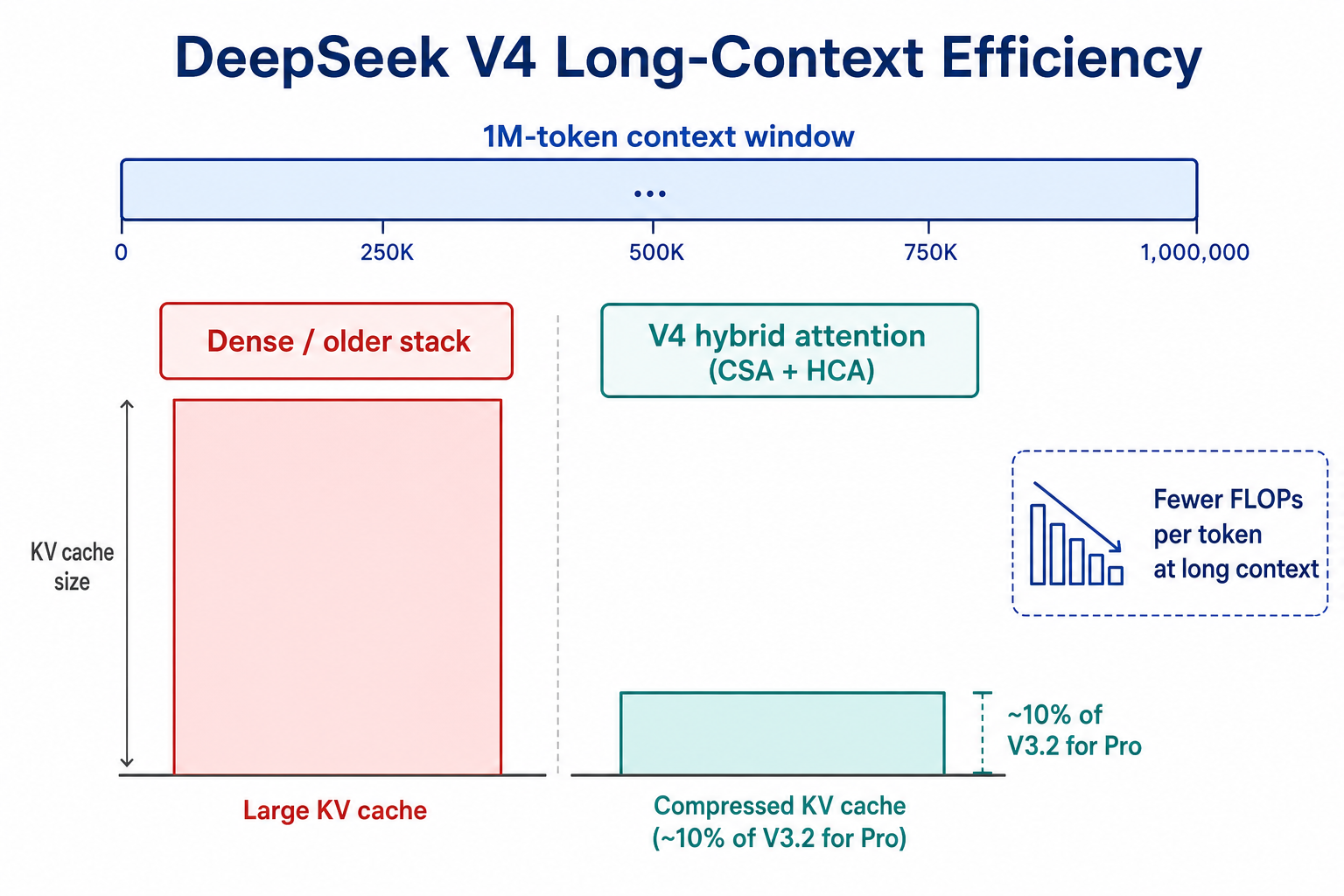
The interesting engineering story in V4 is not only “bigger MoE.” It is making 1M context affordable enough to ship.
At million-token length, a vanilla key–value (KV) cache balloons and becomes the memory wall. Earlier DeepSeek generations already compressed attention across heads. V4 pushes further with a hybrid attention mix—Compressed Sparse Attention (CSA) plus Heavily Compressed Attention (HCA)—to shrink cache and FLOPs along the sequence dimension, where long context actually grows.
DeepSeek’s efficiency framing for the 1M-token setting is aggressive: even V4-Pro is described as needing on the order of ~27% of single-token inference FLOPs and ~10% of the KV cache versus DeepSeek-V3.2, with Flash pushing even lower. Those percentages are lab estimates—not a guarantee for your GPU—but they explain why V4 can advertise both long context and usable serving economics.
Other release notes you will see around V4:
MoE routing with a large expert pool but sparse activation per token.
Mixed precision serving paths (FP8 / FP4-oriented stacks depending on checkpoint), which matter for disk footprint and throughput.
Thinking-style behavior exposed as a controllable mode on some API surfaces, instead of forcing a totally separate “reasoner-only” product ID.
If you self-host, expect quantization choice (BF16 vs Q4-class) to matter as much as the marketing parameter count. Flash is the realistic local starting point for many teams; full Pro weights remain a serious storage and VRAM project.
Key Capabilities and Real-World Jobs
What people actually use DeepSeek V4 for:
Long-document intelligence: ingest books, multi-file research packs, or sprawling tickets without aggressive chunking that loses cross-references.
Professional coding: repo-aware edits, test generation, and agentic coding loops where tool use and instruction following matter.
Reasoning-heavy assistants: math, planning, multi-constraint business analysis—especially on Pro.
Multilingual office text: Chinese/English (and broader East Asian) professional wording for contracts, reports, and bilingual drafts.
Cost-aware production APIs: Flash-tier serving when you need volume without paying closed-frontier rates for every token.
V4 is still a language-model family. If your product is image-native or needs the latest multimodal bells, verify the exact checkpoint and tooling stack before you assume parity with closed multimodal suites.
How to Access DeepSeek V4 (API, Weights, Self-Host)
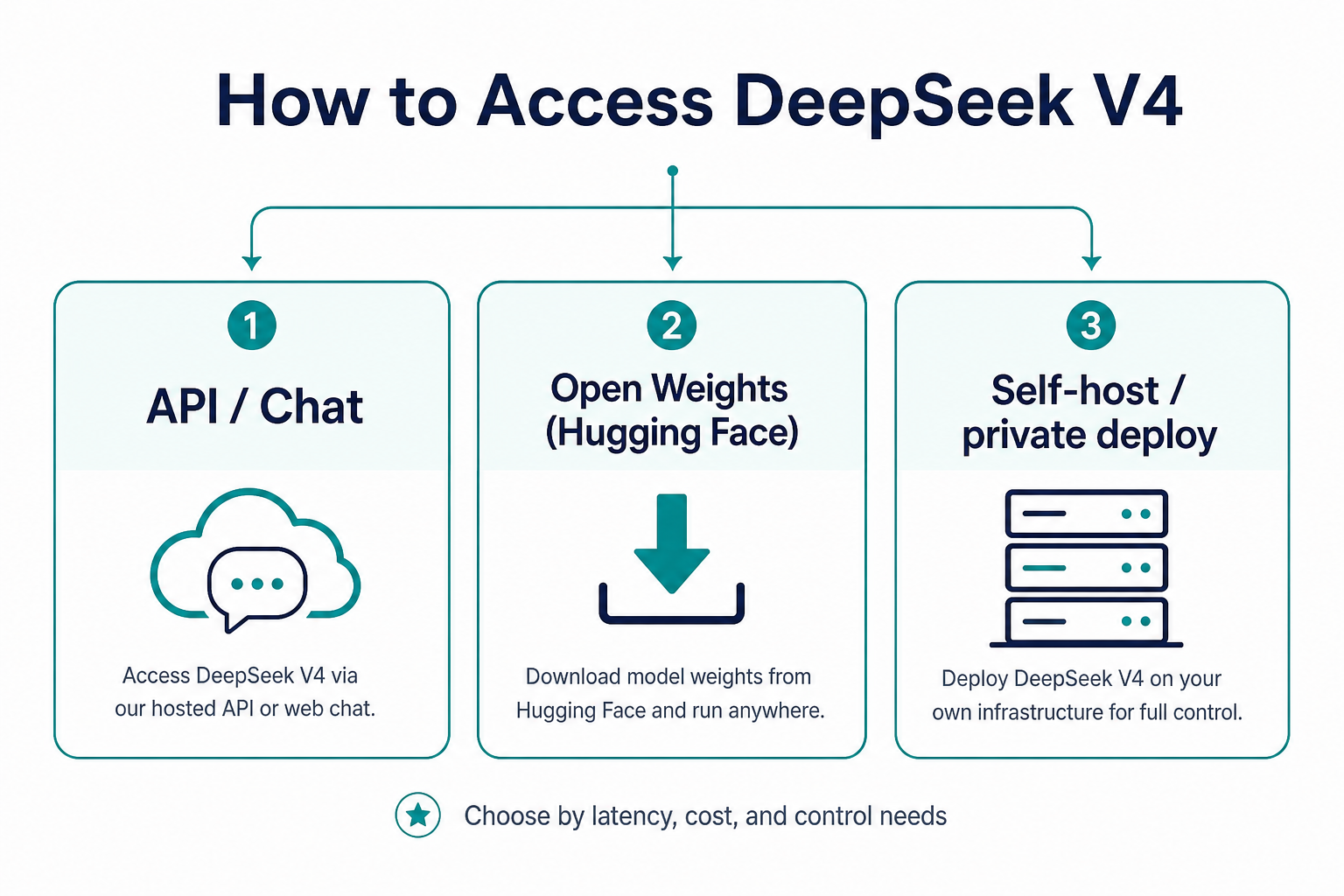
Official API / chat. Call hosted V4 endpoints (Pro vs Flash / Expert vs Instant naming varies by surface). Best when you want zero GPU ops and usage-based billing.
Open weights. Download published checkpoints (for example from Hugging Face / ModelScope mirrors) under MIT terms. Best when you need inspection, fine-tuning, or air-gapped control.
Self-host / private cluster. Serve with MoE-capable runtimes. Plan for disk, interconnect, and quantization early—Pro is heavy.
Hardware baselines move with quantization, but community guidance often puts Flash in reach of multi-GPU boxes at aggressive quants, while Pro expects dedicated high-memory servers. Always size from the checkpoint card and your serving framework, not from a single blog number.
DeepSeek V4 vs Other Mainstream Models
| Comparison | Practical takeaway |
|---|---|
| vs DeepSeek V3 / V3.2 | V4’s main leap is long-context efficiency plus a cleaner Pro/Flash product split. Expect better 1M-window economics and stronger overall reasoning/coding than prior open DeepSeek stacks in many internal evals. |
| vs closed GPT / Claude-class APIs | DeepSeek V4 typically wins on open weights, self-host options, and token price. Closed models may still lead on some polish-heavy or multimodal product surfaces—run a bake-off on your prompts. |
| vs other open MoE rivals | Compete on coding benches, Chinese/English balance, and whether 1M context is actually usable under your memory budget. MIT licensing is a real ops advantage for commercial redistribute scenarios. |
There is no universal “best model.” There is a best fit for latency, cost, language mix, and whether you must keep weights on your own metal.


A Lightweight Path: DeepSeek-Backed Tools in WPS Office
If your goal is finishing documents—not standing up GPUs—some office suites already expose DeepSeek-backed rewrite, summarize, and translate helpers. The international version of WPS Office is one of those paths: AI tools sit inside Writer / Spreadsheet / PDF so you avoid chat-to-doc copy-paste.
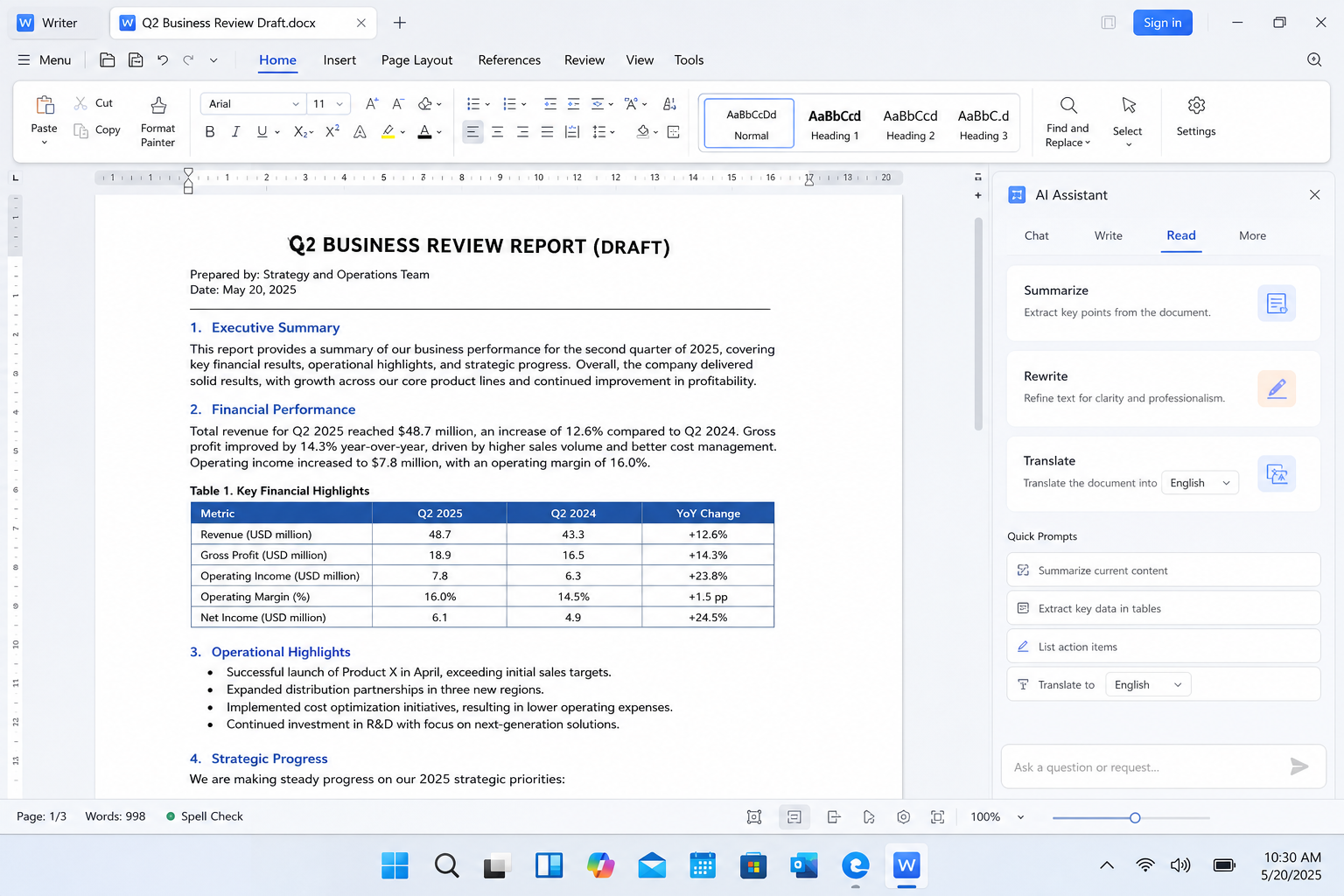
Download the official international build, sign in, and use the AI features available in your account tier. This does not replace API or open-weight control for engineers—it is simply the shortest route for everyday files.
FAQs About DeepSeek V4
What is DeepSeek V4 in one sentence?
DeepSeek V4 is an open-weight MoE model family (V4-Pro and V4-Flash) built for high-efficiency reasoning and coding with a native 1-million-token context window under an MIT license.
What is the difference between DeepSeek V4-Pro and V4-Flash?
V4-Pro is the flagship (~1.6T total / ~49B activated) for hard reasoning, large codebases, and agent work. V4-Flash (~284B total / ~13B activated) targets lower latency and cost for everyday chat and routine coding. Both share the 1M context design.
Is DeepSeek V4 open source / MIT licensed?
Yes—the published V4 weights are released under the MIT license on channels such as Hugging Face. Always check the license file that ships with the exact checkpoint you download.
Does DeepSeek V4 really support 1 million tokens?
The V4 series is designed for a native 1M-token context. Practical throughput still depends on your serving stack, quantization, and hardware memory—not only the paper number.
Which edition should I choose for production?
Default to V4-Flash when latency and spend matter and the task is routine. Move to V4-Pro when accuracy on long, multi-step, or agentic jobs is the bottleneck.
How can I try DeepSeek V4 without self-hosting?
Use the official DeepSeek API or chat product when available in your region, or use office apps that already embed DeepSeek-backed AI—such as DeepSeek-powered helpers inside the international version of WPS Office.
Summary
DeepSeek V4 is a two-tier MoE family: V4-Pro for maximum reasoning/coding depth and V4-Flash for efficient everyday volume—both aiming at a practical 1M-token context via compressed attention, with MIT-licensed open weights. Choose Pro when mistakes are expensive; choose Flash when latency and spend dominate. Call the API, download weights, or self-host based on control needs. If you only need AI on documents today, DeepSeek-backed tools inside WPS Office are a lightweight optional path.

'%3e%3cpath%20d='M19.9911%204.11386V6.471H18.5894C18.0775%206.471%2017.7322%206.57814%2017.5536%206.79243C17.3751%207.00671%2017.2858%207.32814%2017.2858%207.75671V9.44421H19.9019L19.5536%2012.0871H17.2858V18.8639H14.5536V12.0871H12.2769V9.44421H14.5536V7.49779C14.5536%206.39064%2014.8632%205.53201%2015.4822%204.92189C16.1013%204.31177%2016.9257%204.00671%2017.9554%204.00671C18.8304%204.00671%2019.509%204.04243%2019.9911%204.11386Z'%20fill='%23333333'/%3e%3c/g%3e%3cdefs%3e%3cclipPath%20id='clip0_2938_8199'%3e%3crect%20width='16'%20height='16'%20fill='white'%20transform='translate(8%204.00671)'/%3e%3c/clipPath%3e%3c/defs%3e%3c/svg%3e)
'%3e%3cpath%20d='M17.5237%2010.7813L23.4811%204H22.0699L16.8949%209.88693L12.7648%204H8L14.2469%2012.9029L8%2020.0133H9.4112L14.8725%2013.7952L19.2352%2020.0133H24M9.92053%205.04213H12.0885L22.0688%2019.0224H19.9003'%20fill='%23333333'/%3e%3c/g%3e%3cdefs%3e%3cclipPath%20id='clip0_2938_8200'%3e%3crect%20width='16'%20height='16.0134'%20fill='white'%20transform='translate(8%204)'/%3e%3c/clipPath%3e%3c/defs%3e%3c/svg%3e)


