

'%3e%3cpath%20d='M8%200C12.4183%200%2016%203.58172%2016%208C16%2012.4183%2012.4183%2016%208%2016C3.58172%2016%200%2012.4183%200%208C0%203.58172%203.58172%200%208%200ZM11.6162%204.38379C11.2257%203.99337%2010.5927%203.99338%2010.2021%204.38379L8%206.58594L5.79785%204.38379C5.40732%203.99334%204.77429%203.99329%204.38379%204.38379C3.99331%204.77429%203.99335%205.40733%204.38379%205.79785L6.58594%208L4.38379%2010.2021C3.99348%2010.5927%203.99341%2011.2257%204.38379%2011.6162C4.77426%2012.0066%205.40734%2012.0065%205.79785%2011.6162L8%209.41406L10.2021%2011.6162C10.5927%2012.0066%2011.2257%2012.0067%2011.6162%2011.6162C12.0067%2011.2257%2012.0066%2010.5927%2011.6162%2010.2021L9.41406%208L11.6162%205.79785C12.0066%205.40735%2012.0066%204.77429%2011.6162%204.38379Z'%20fill='%23080E17'%20fill-opacity='0.46'/%3e%3c/g%3e%3cdefs%3e%3cclipPath%20id='clip0_3761_713'%3e%3crect%20width='16'%20height='16'%20fill='white'/%3e%3c/clipPath%3e%3c/defs%3e%3c/svg%3e)



'%3e%3cpath%20fill-rule='evenodd'%20clip-rule='evenodd'%20d='M21.4999%2010.9993C21.4999%205.20009%2016.7986%200.498901%2010.9993%200.498901C5.19994%200.498901%200.498657%205.20009%200.498657%2010.9993C0.498657%2016.2404%204.33858%2020.5844%209.35855%2021.3722V14.0346H6.69238V10.9993H9.35855V8.68594C9.35855%206.05427%2010.9262%204.60062%2013.3248%204.60062C14.4736%204.60062%2015.6753%204.80571%2015.6753%204.80571V7.38979H14.3512C13.0468%207.38979%2012.64%208.19921%2012.64%209.0296V10.9993H15.5523L15.0867%2014.0346H12.64V21.3722C17.66%2020.5844%2021.4999%2016.2404%2021.4999%2010.9993Z'%20fill='%231568EA'/%3e%3c/g%3e%3c/svg%3e)


'%3e%3cpath%20d='M2.42045%2022.1876H6.31818V12.7217L0.75%208.54553V20.5171C0.75%2021.4414%201.49892%2022.1876%202.42045%2022.1876Z'%20fill='%234285F4'/%3e%3cpath%20d='M19.682%2022.1876H23.5797C24.5041%2022.1876%2025.2502%2021.4387%2025.2502%2020.5171V8.54553L19.682%2012.7217'%20fill='%2334A853'/%3e%3cpath%20d='M19.682%205.48293V12.7216L25.2502%208.54543V6.31816C25.2502%204.25236%2022.8921%203.07469%2021.2411%204.31361'%20fill='%23FBBC04'/%3e%3cpath%20d='M6.31824%2012.7217V5.48303L13.0001%2010.4944L19.6819%205.48303V12.7217L13.0001%2017.733'%20fill='%23EA4335'/%3e%3cpath%20d='M0.75%206.31816V8.54543L6.31818%2012.7216V5.48293L4.75909%204.31361C3.10534%203.07469%200.75%204.25236%200.75%206.31816Z'%20fill='%23C5221F'/%3e%3c/g%3e%3cdefs%3e%3cclipPath%20id='clip0_2954_7305'%3e%3crect%20width='24.5'%20height='18.375'%20fill='white'%20transform='translate(0.75%203.8125)'/%3e%3c/clipPath%3e%3c/defs%3e%3c/svg%3e)


You have found the perfect quote for your essay, but dropping the exact sentence into every paragraph makes your writing feel stitched together. The way out is to paraphrase a quote: restate what the author said in your own words and sentence structure, while keeping the meaning and giving credit.
This guide walks through when paraphrasing beats quoting, how to paraphrase a quote step by step, how to cite it in MLA and APA, and the mistakes that turn a good paraphrase into accidental plagiarism.
How to Paraphrase a Quote: Step-by-Step with Examples
When to Paraphrase a Quote Instead of Quoting Directly
A direct quote copies the author's exact words inside quotation marks. Paraphrasing restates the same idea in your own words and sentence structure, at roughly the same length, without quotation marks around the reworded text. Both are legitimate; the choice depends on which part of the source matters.
Paraphrase a quote when the idea matters more than the wording. If the author's phrasing is technical, wordy, or hard to follow, a paraphrase in plain language serves your reader better. Paraphrasing also keeps your own voice dominant across a paragraph, which is why literature reviews rely on it so heavily. Reserve direct quotes for language worth preserving exactly: a striking phrase, a definition, a contested claim, or testimony you may need to analyze word by word.
One warning applies either way: rewording never removes the need to cite. Whether you quote or paraphrase, the idea still belongs to its author. For a fuller walkthrough of the underlying skill, see our guide on what paraphrasing is and how to do it correctly.
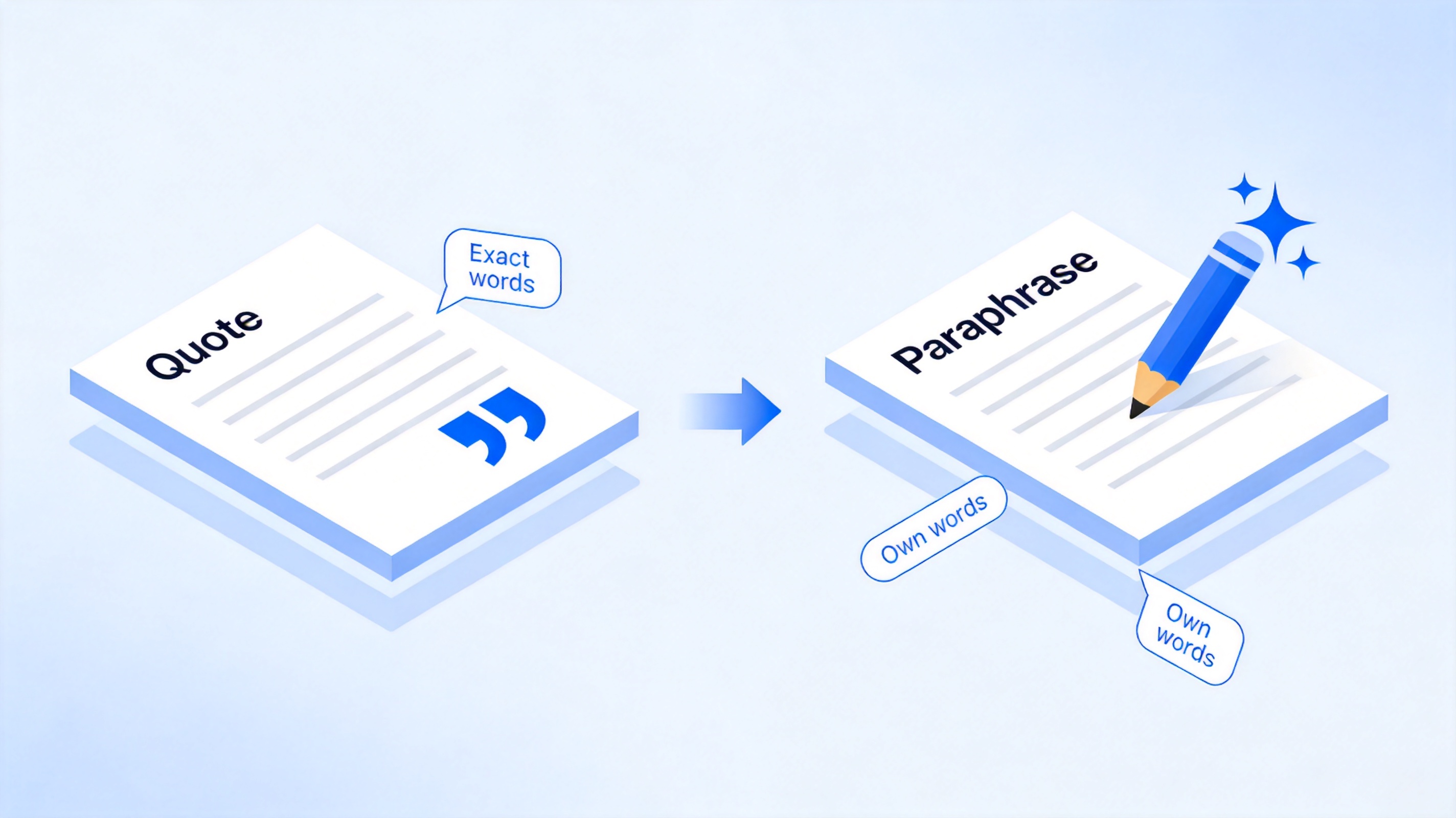
Paraphrase a quote versus quoting directly


How to Paraphrase a Quote Step by Step
A clean paraphrase separates understanding from writing. The sequence below takes a few minutes per quote and removes most of the risk of wording that is too close to the original.
Read the quote several times. Make sure you could explain it out loud in your own words before writing anything. Look up any unfamiliar terms.
Note the key point. Jot down just the claim and its cause or condition—not the sentences that carry them.
Put the source out of sight. Close the book or browser tab so the original wording cannot anchor your sentence structure.
Write the idea from memory. Build a new sentence skeleton: change clause order, split or merge sentences, and switch voice where it sounds natural. Keep the same level of detail.
Compare with the original. Reopen the source and check that your meaning matches and that no phrase survives unchanged (except unavoidable terms like "cognitive dissonance").
Cite the source. Add the in-text citation and reference entry for the original author. Rewording does not change ownership.
The four phases below cover the whole sequence: steps 1–2 are Read, steps 3–4 are Rewrite, step 5 is Compare, and step 6 is Cite.
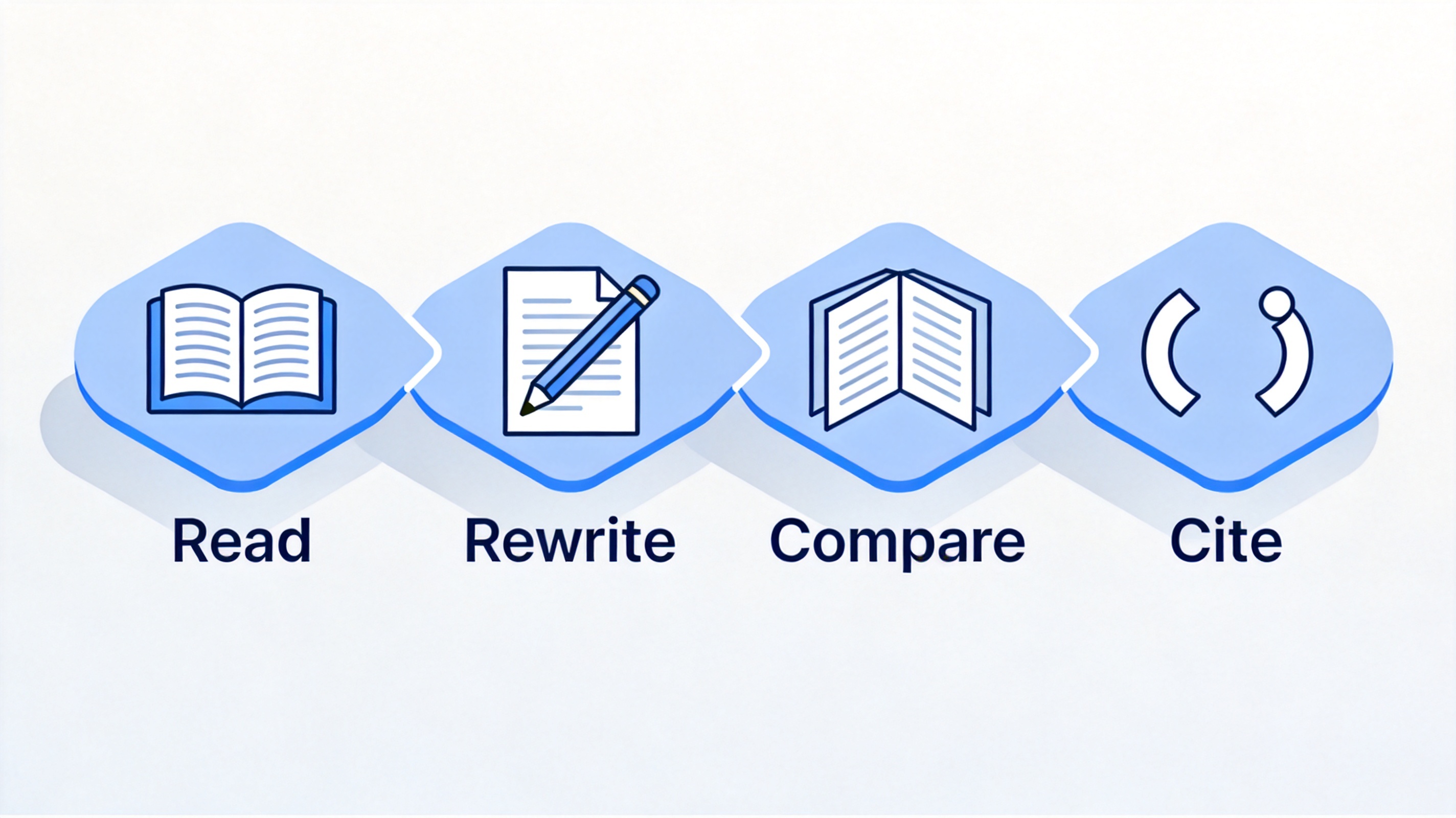
Four steps to paraphrase a quote
How to Cite a Paraphrased Quote in MLA and APA
Citation is where paraphrasing most often goes wrong, because writers assume new words mean no citation. Every major style requires attribution for paraphrased material—the formats just differ slightly.
MLA: give the author and page in parentheses, or name the author in a signal phrase: As Morrison argues, Beloved's haunting is literal (54). No works-cited-entry change is needed for a paraphrase versus a quote.
APA: give the author and year: (Morrison, 1987). A page number is optional for a paraphrase but good practice when restating a specific passage; it is required for direct quotes.
Quote within a quote: if the source you read cites someone else, credit what you actually read. MLA uses "qtd. in"— (qtd. in Pfanner 22)—and APA names only the secondary source with the original mentioned in the text.
For direct quoting rules alongside paraphrasing, the MLA quotes guide covers block quotes, signal phrases, and punctuation in detail.

Cite a paraphrased quote in MLA and APA
Before and After Examples of Paraphrasing a Quote
One worked example makes the method concrete. Take this original quote: "Regular exercise improves sleep quality because it lowers stress hormones that interfere with rest."
Too close (word swap): "Regular workouts enhance sleep quality because they reduce stress hormones that disrupt rest." The sentence skeleton, rhythm, and logic are identical—only synonyms moved. Instructors and plagiarism checkers flag this immediately.
Correct paraphrase: People who exercise consistently tend to sleep better, since physical activity reduces the hormones that make it hard to rest (Author, Year). The claim and its cause survive intact, but the structure and wording are entirely new, and the citation still points to the original source.
Run the same check on your own drafts: if a reader could spot the source sentence at a glance, rework the structure before you add the citation.
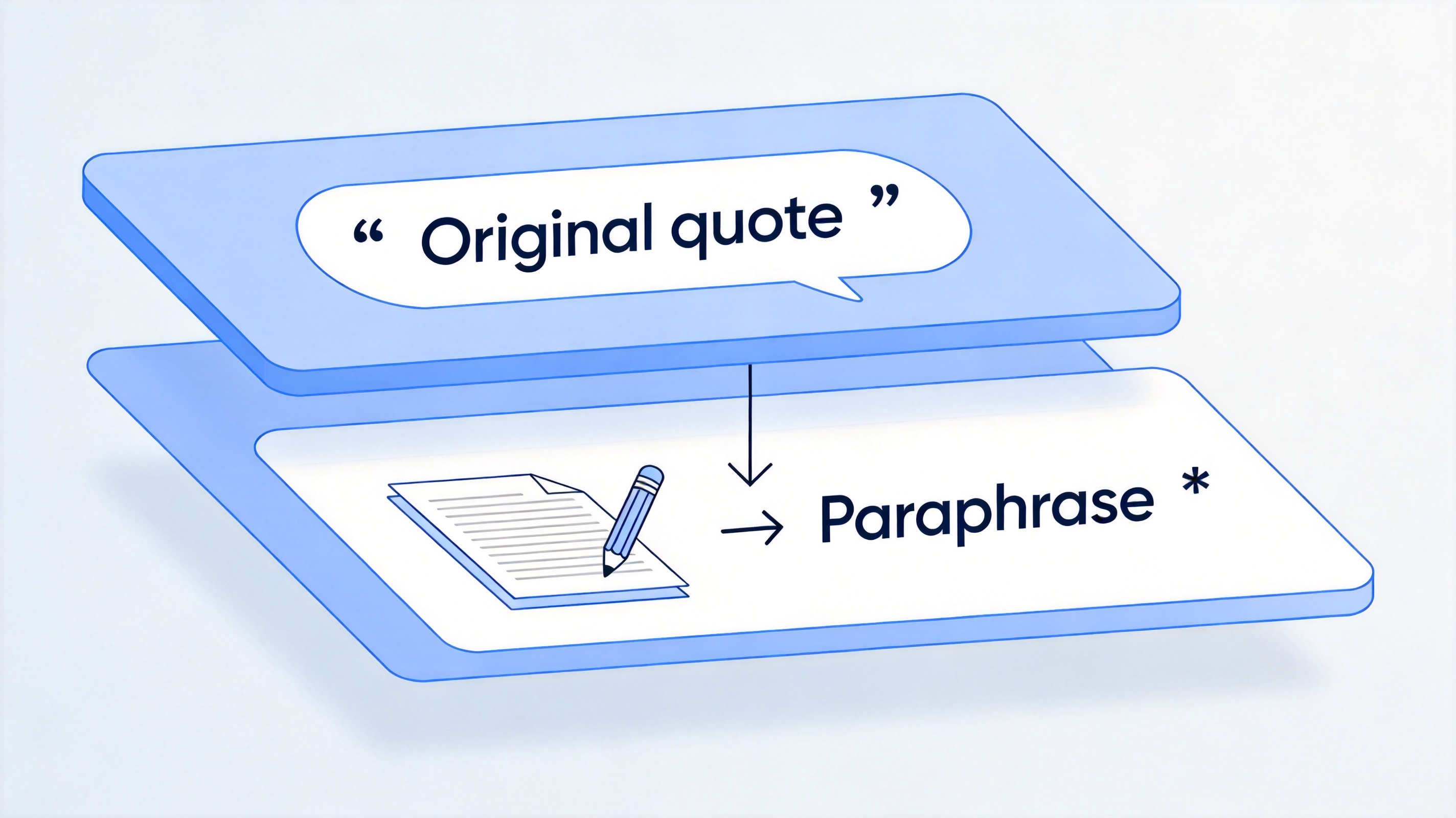
Before and after example of paraphrasing a quote
Common Mistakes When You Paraphrase a Quote
Most paraphrasing problems fall into three patterns, and each has a quick fix.
The synonym swap. Replacing single words while keeping the original sentence skeleton produces text that reads as borrowed. Change the structure instead: reorder clauses, split sentences, or shift between active and passive voice.
Drifting meaning. A paraphrase must carry the author's claim, not an exaggerated or softened version of it. Keep your own commentary in a separate sentence, clearly in your voice.
Dropping the citation. New wording does not create new ownership. A paraphrased quote needs the same attribution a direct quote would get.
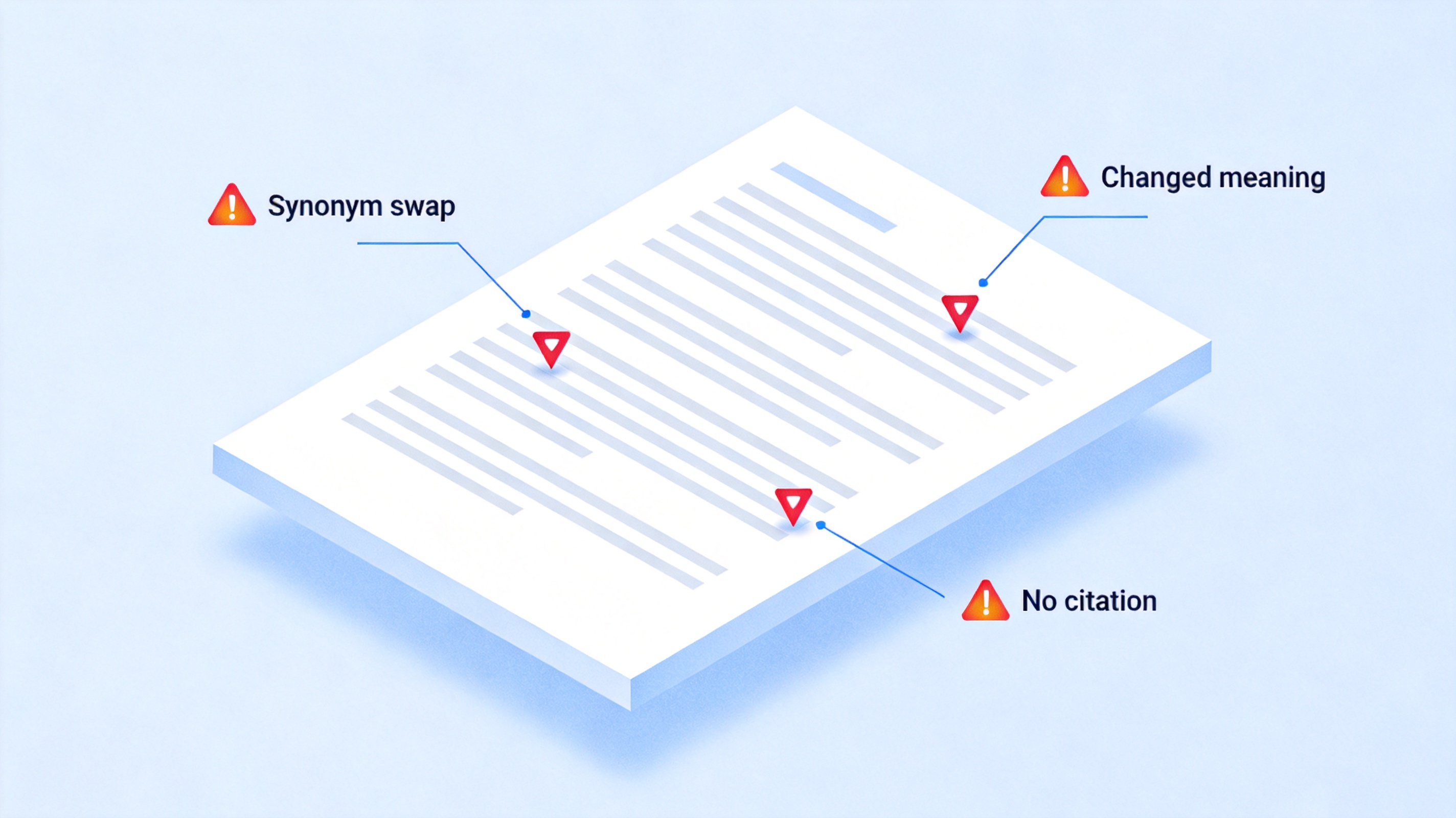
Common mistakes when paraphrasing a quote
The Best Free Alternative: WPS Office
Paraphrasing happens inside a draft, so the surrounding tooling matters. WPS Office puts rewording tools directly in Writer: select a quoted passage, and WPS AI can rephrase it, adjust the tone, or shorten a long quote—without copying text into a separate tab and pasting it back.
Because the rewrite stays in the same document, your formatting, headings, and citations stay in place while you compare versions side by side. Writer is free for personal use, opens and saves .docx files, and works on desktop, web, and mobile.
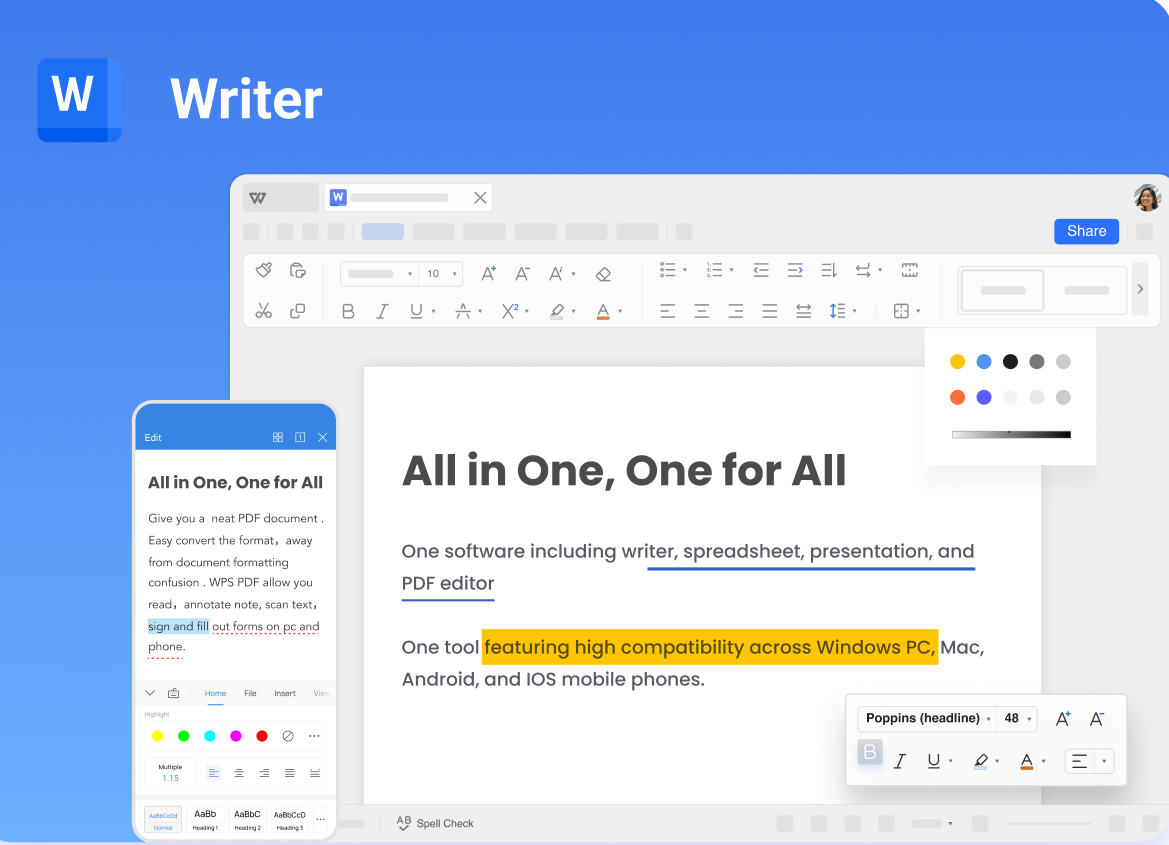
WPS Writer
FAQs
Do quotation marks disappear when you paraphrase a quote?
Yes. Quotation marks mark the author's exact words. Once you restate the idea in your own words, drop the quotation marks—but keep the citation, which now attributes the idea rather than the wording. If you keep any distinctive phrase from the original, put just that phrase in quotes.
Is paraphrasing a quote plagiarism?
Not if you cite it. Plagiarism is reusing someone's idea without attribution, or presenting wording that is still too close to the original. Change the sentence structure, preserve the meaning, and cite the source, and the paraphrase is legitimate.
How different does a paraphrase need to be?
Different enough that a reader could not reconstruct the original sentence from yours. Keep only unavoidable terms—proper nouns, technical labels, statistics—and rebuild everything else: clause order, sentence length, and grammar.
How do I paraphrase a quote I found inside another source?
Credit the source you actually read, and make the indirection clear. In MLA, add "qtd. in" before your source in the citation; in APA, cite only the secondary source and name the original author in your sentence. Track down the original whenever it is available.
Can I mix a quote and a paraphrase in one sentence?
Yes, and it is a common technique: paraphrase the surrounding idea and quote only the few words worth preserving exactly, in quotation marks inside your sentence. Cite once at the end, with a page number for the quoted words.


'%3e%3cpath%20d='M19.9911%204.11386V6.471H18.5894C18.0775%206.471%2017.7322%206.57814%2017.5536%206.79243C17.3751%207.00671%2017.2858%207.32814%2017.2858%207.75671V9.44421H19.9019L19.5536%2012.0871H17.2858V18.8639H14.5536V12.0871H12.2769V9.44421H14.5536V7.49779C14.5536%206.39064%2014.8632%205.53201%2015.4822%204.92189C16.1013%204.31177%2016.9257%204.00671%2017.9554%204.00671C18.8304%204.00671%2019.509%204.04243%2019.9911%204.11386Z'%20fill='%23333333'/%3e%3c/g%3e%3cdefs%3e%3cclipPath%20id='clip0_2938_8199'%3e%3crect%20width='16'%20height='16'%20fill='white'%20transform='translate(8%204.00671)'/%3e%3c/clipPath%3e%3c/defs%3e%3c/svg%3e)
'%3e%3cpath%20d='M17.5237%2010.7813L23.4811%204H22.0699L16.8949%209.88693L12.7648%204H8L14.2469%2012.9029L8%2020.0133H9.4112L14.8725%2013.7952L19.2352%2020.0133H24M9.92053%205.04213H12.0885L22.0688%2019.0224H19.9003'%20fill='%23333333'/%3e%3c/g%3e%3cdefs%3e%3cclipPath%20id='clip0_2938_8200'%3e%3crect%20width='16'%20height='16.0134'%20fill='white'%20transform='translate(8%204)'/%3e%3c/clipPath%3e%3c/defs%3e%3c/svg%3e)


