

'%3e%3cpath%20d='M8%200C12.4183%200%2016%203.58172%2016%208C16%2012.4183%2012.4183%2016%208%2016C3.58172%2016%200%2012.4183%200%208C0%203.58172%203.58172%200%208%200ZM11.6162%204.38379C11.2257%203.99337%2010.5927%203.99338%2010.2021%204.38379L8%206.58594L5.79785%204.38379C5.40732%203.99334%204.77429%203.99329%204.38379%204.38379C3.99331%204.77429%203.99335%205.40733%204.38379%205.79785L6.58594%208L4.38379%2010.2021C3.99348%2010.5927%203.99341%2011.2257%204.38379%2011.6162C4.77426%2012.0066%205.40734%2012.0065%205.79785%2011.6162L8%209.41406L10.2021%2011.6162C10.5927%2012.0066%2011.2257%2012.0067%2011.6162%2011.6162C12.0067%2011.2257%2012.0066%2010.5927%2011.6162%2010.2021L9.41406%208L11.6162%205.79785C12.0066%205.40735%2012.0066%204.77429%2011.6162%204.38379Z'%20fill='%23080E17'%20fill-opacity='0.46'/%3e%3c/g%3e%3cdefs%3e%3cclipPath%20id='clip0_3761_713'%3e%3crect%20width='16'%20height='16'%20fill='white'/%3e%3c/clipPath%3e%3c/defs%3e%3c/svg%3e)



'%3e%3cpath%20fill-rule='evenodd'%20clip-rule='evenodd'%20d='M21.4999%2010.9993C21.4999%205.20009%2016.7986%200.498901%2010.9993%200.498901C5.19994%200.498901%200.498657%205.20009%200.498657%2010.9993C0.498657%2016.2404%204.33858%2020.5844%209.35855%2021.3722V14.0346H6.69238V10.9993H9.35855V8.68594C9.35855%206.05427%2010.9262%204.60062%2013.3248%204.60062C14.4736%204.60062%2015.6753%204.80571%2015.6753%204.80571V7.38979H14.3512C13.0468%207.38979%2012.64%208.19921%2012.64%209.0296V10.9993H15.5523L15.0867%2014.0346H12.64V21.3722C17.66%2020.5844%2021.4999%2016.2404%2021.4999%2010.9993Z'%20fill='%231568EA'/%3e%3c/g%3e%3c/svg%3e)


'%3e%3cpath%20d='M2.42045%2022.1876H6.31818V12.7217L0.75%208.54553V20.5171C0.75%2021.4414%201.49892%2022.1876%202.42045%2022.1876Z'%20fill='%234285F4'/%3e%3cpath%20d='M19.682%2022.1876H23.5797C24.5041%2022.1876%2025.2502%2021.4387%2025.2502%2020.5171V8.54553L19.682%2012.7217'%20fill='%2334A853'/%3e%3cpath%20d='M19.682%205.48293V12.7216L25.2502%208.54543V6.31816C25.2502%204.25236%2022.8921%203.07469%2021.2411%204.31361'%20fill='%23FBBC04'/%3e%3cpath%20d='M6.31824%2012.7217V5.48303L13.0001%2010.4944L19.6819%205.48303V12.7217L13.0001%2017.733'%20fill='%23EA4335'/%3e%3cpath%20d='M0.75%206.31816V8.54543L6.31818%2012.7216V5.48293L4.75909%204.31361C3.10534%203.07469%200.75%204.25236%200.75%206.31816Z'%20fill='%23C5221F'/%3e%3c/g%3e%3cdefs%3e%3cclipPath%20id='clip0_2954_7305'%3e%3crect%20width='24.5'%20height='18.375'%20fill='white'%20transform='translate(0.75%203.8125)'/%3e%3c/clipPath%3e%3c/defs%3e%3c/svg%3e)


Strong transition words for paragraphs tell readers how each new idea connects to the last one — contrast, addition, cause, or conclusion. Below are 84 transition words grouped by function, with placement rules and before-and-after examples you can copy straight into your essay.
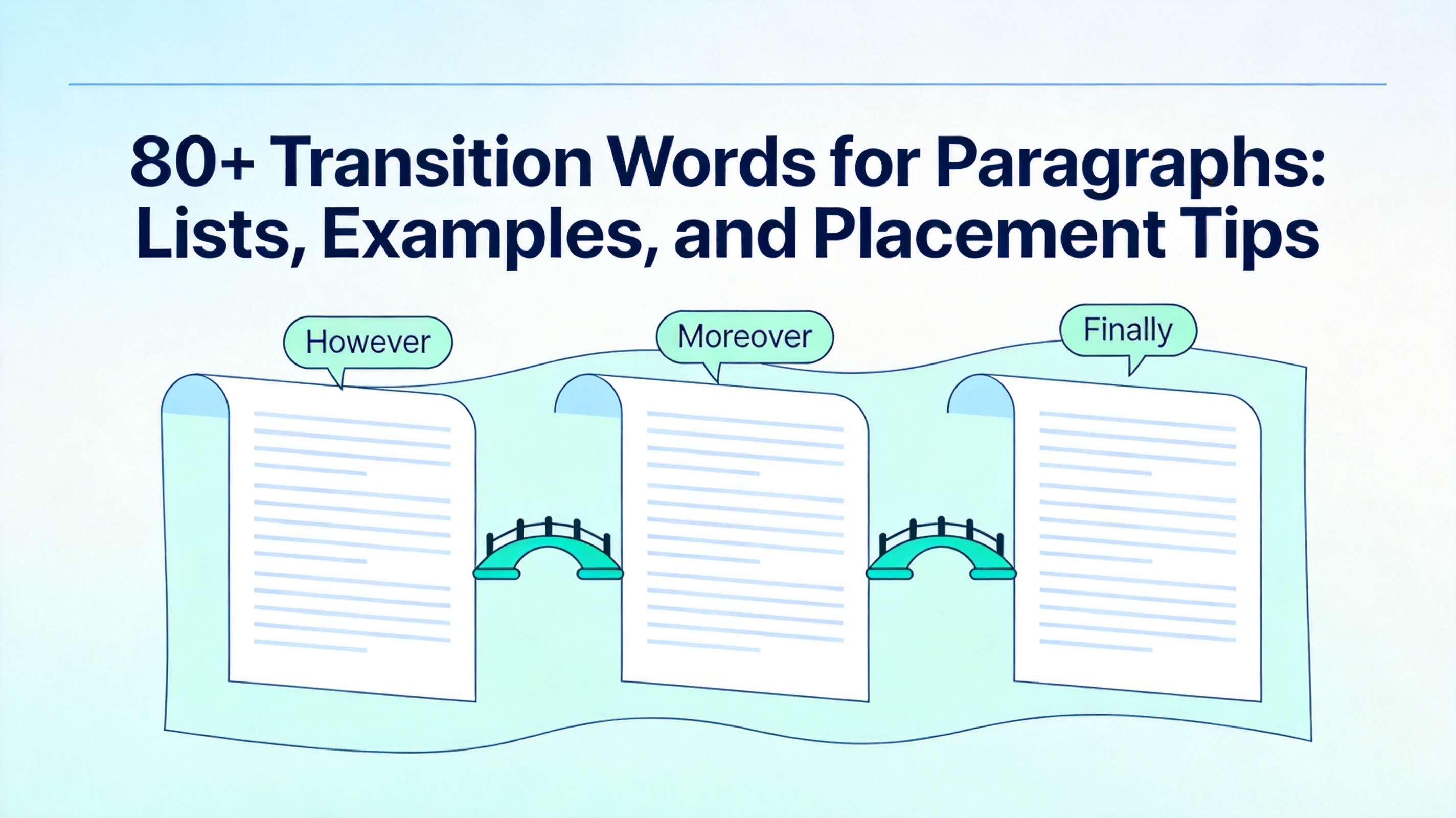
80+ Transition Words for Paragraphs: Lists, Examples, and Placement Tips
80+ Transition Words for Paragraphs (By Function)
Pick a transition by the relationship you want to show, not by how advanced the word sounds. Each category below answers a different reader question: "What else?", "But what about…?", "So what happened?", and so on. The full list adds up to 84 words and phrases, so you can vary your wording across a long essay without repeating yourself.
Addition (10)
- Furthermore
- Moreover
- In addition
- Additionally
- Also
- Besides
- Equally important
- What's more
- Along with
- On top of that
Contrast (10)
- However
- Nevertheless
- On the other hand
- In contrast
- Conversely
- Although
- Whereas
- Yet
- Still
- Nonetheless
Cause and Effect (10)
- Therefore
- Consequently
- As a result
- Thus
- Hence
- Accordingly
- Because of this
- For this reason
- So
- It follows that
Example and Illustration (8)
- For instance
- For example
- Such as
- Specifically
- To illustrate
- Namely
- In particular
- To demonstrate
Emphasis and Clarification (8)
- Indeed
- In fact
- Certainly
- Undoubtedly
- Especially
- Above all
- Notably
- In other words
Time and Sequence (10)
- First
- Second
- Next
- Then
- Finally
- Subsequently
- Afterward
- Meanwhile
- Eventually
- At the same time
Conclusion and Summary (8)
- In conclusion
- To summarize
- In summary
- Ultimately
- Overall
- All in all
- To sum up
- In closing
Concession (6)
- Admittedly
- Granted
- Even though
- While it is true
- Of course
- Regardless
Similarity (6)
- In the same way
- By the same token
- Equally
- Just as
- Comparable to
- In a similar fashion
Condition (8)
- If
- Unless
- Provided that
- In case
- Even if
- Only if
- Whether or not
- Assuming that
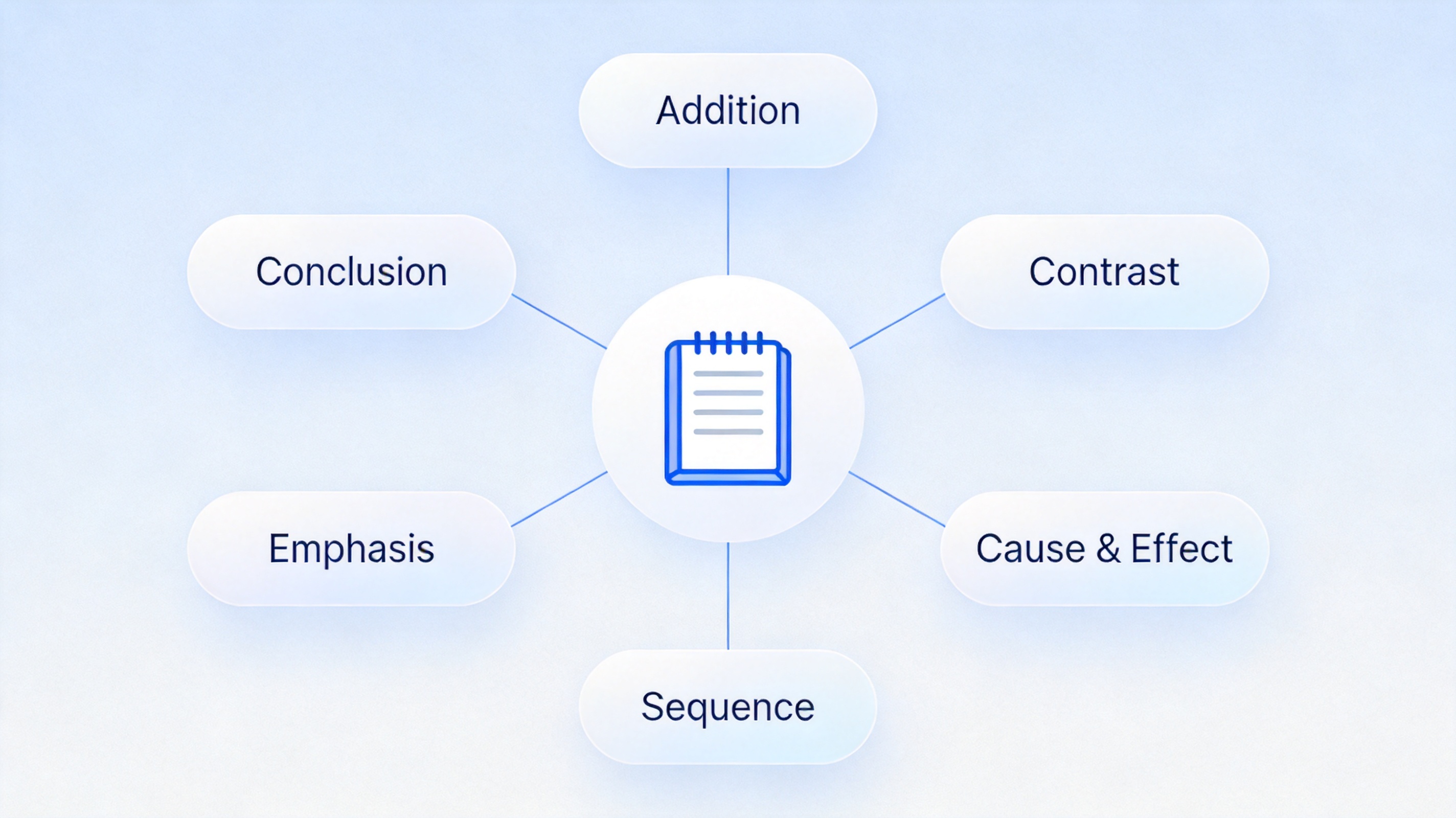
Transition word categories reference chart
How to Place Transition Words Between Paragraphs
A transition word usually works best as the first word of the new paragraph, because that is where the reader asks "how does this connect to what I just read?" Follow these steps when you edit a draft:
- Read the last sentence of the previous paragraph. Decide the relationship: continuing, contrasting, causing, or concluding.
- Open the new paragraph with a matching transition from the category above, followed by a comma: However, the survey told a different story…
- Check the sentence still makes sense alone. If removing the transition changes the meaning, the transition is doing real work; if not, cut it.
- Vary position for longer phrases. Mid-sentence transitions like "in contrast" can sit after the subject: The first method, in contrast, required no equipment.
- Limit one transition per paragraph opening. Stacking "Moreover, in addition, also" at the start reads as filler.
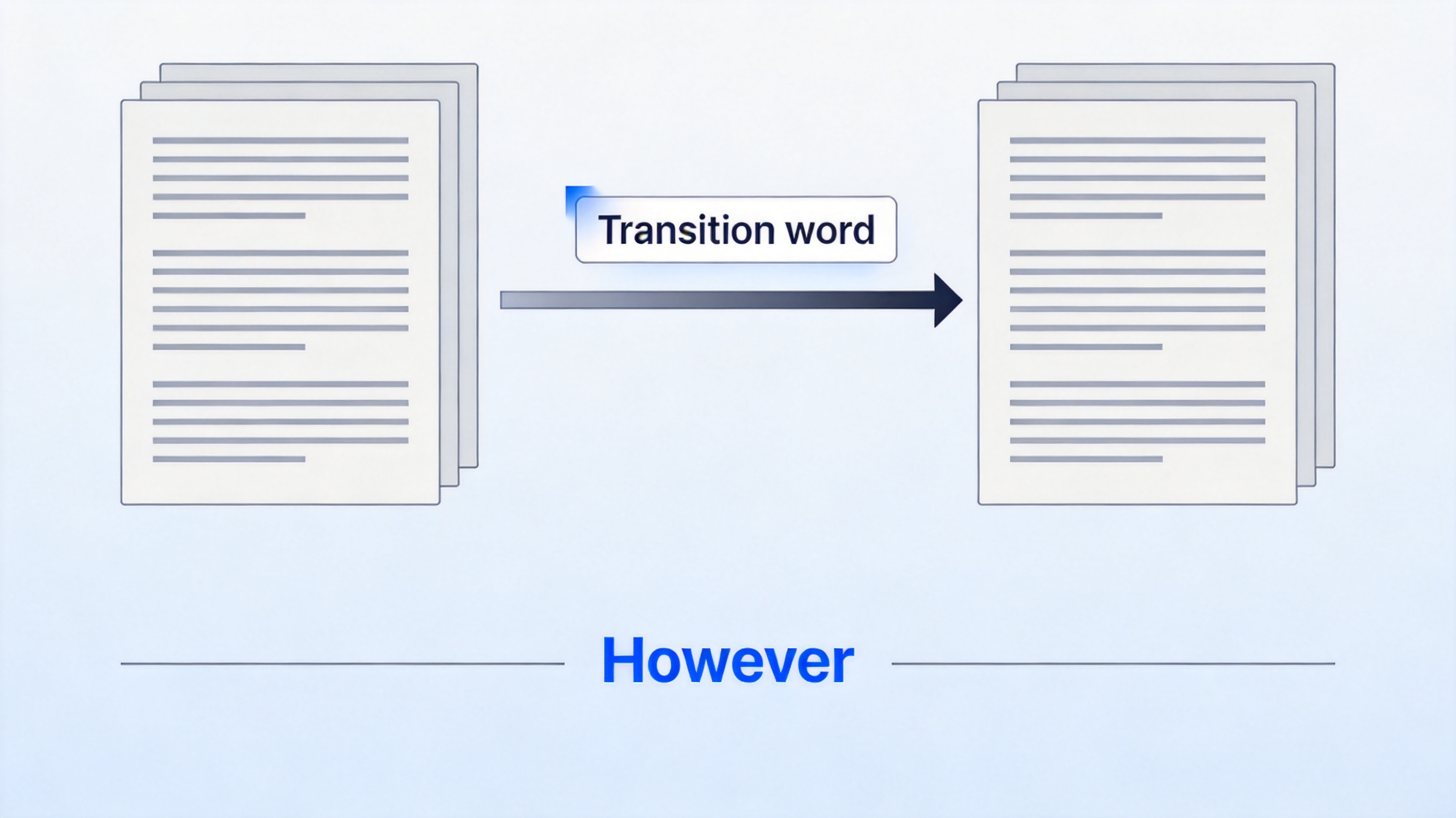
Where to place paragraph transitions
Transition Word Examples: Before and After Paragraphs
The fastest way to feel the difference is to compare drafts. Here are three before-and-after pairs using words from the list:
- Contrast: Online courses are cheaper. They have lower completion rates. → Online courses are cheaper. However, they have lower completion rates.
- Cause and effect: The bridge was uninspected. Traffic was rerouted for a month. → The bridge was uninspected. Consequently, traffic was rerouted for a month.
- Conclusion: Costs fell, reviews improved, and staff stayed longer. The new schedule worked. → Costs fell, reviews improved, and staff stayed longer. All in all, the new schedule worked.
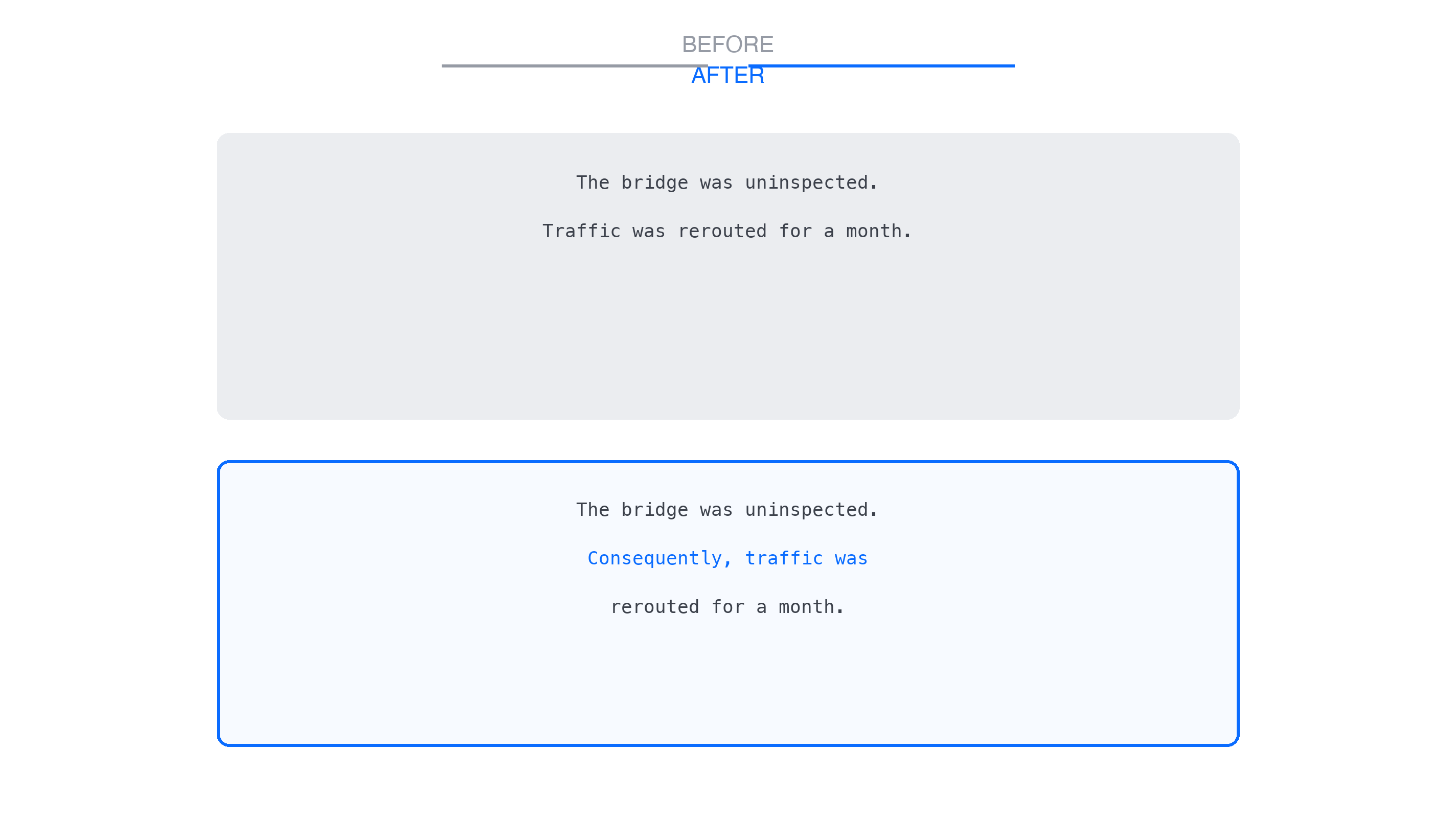
Paragraph with and without transition
Common Mistakes with Transition Words in Paragraphs
Most transition problems come from using the word as decoration rather than as logic. Watch for these four:
- Repeating the same word in every paragraph. Three "Howevers" in a row is a red flag; rotate between However, Nevertheless, and In contrast.
- Choosing a transition that contradicts your logic. "Therefore" after a contrast idea confuses the reader — check the category first.
- Forgetting the comma. Introductory transitions take a comma: Moreover, … not Moreover …
- Transitioning every single sentence. Sentences inside a paragraph often flow fine without connectors; save transitions for real shifts between ideas.
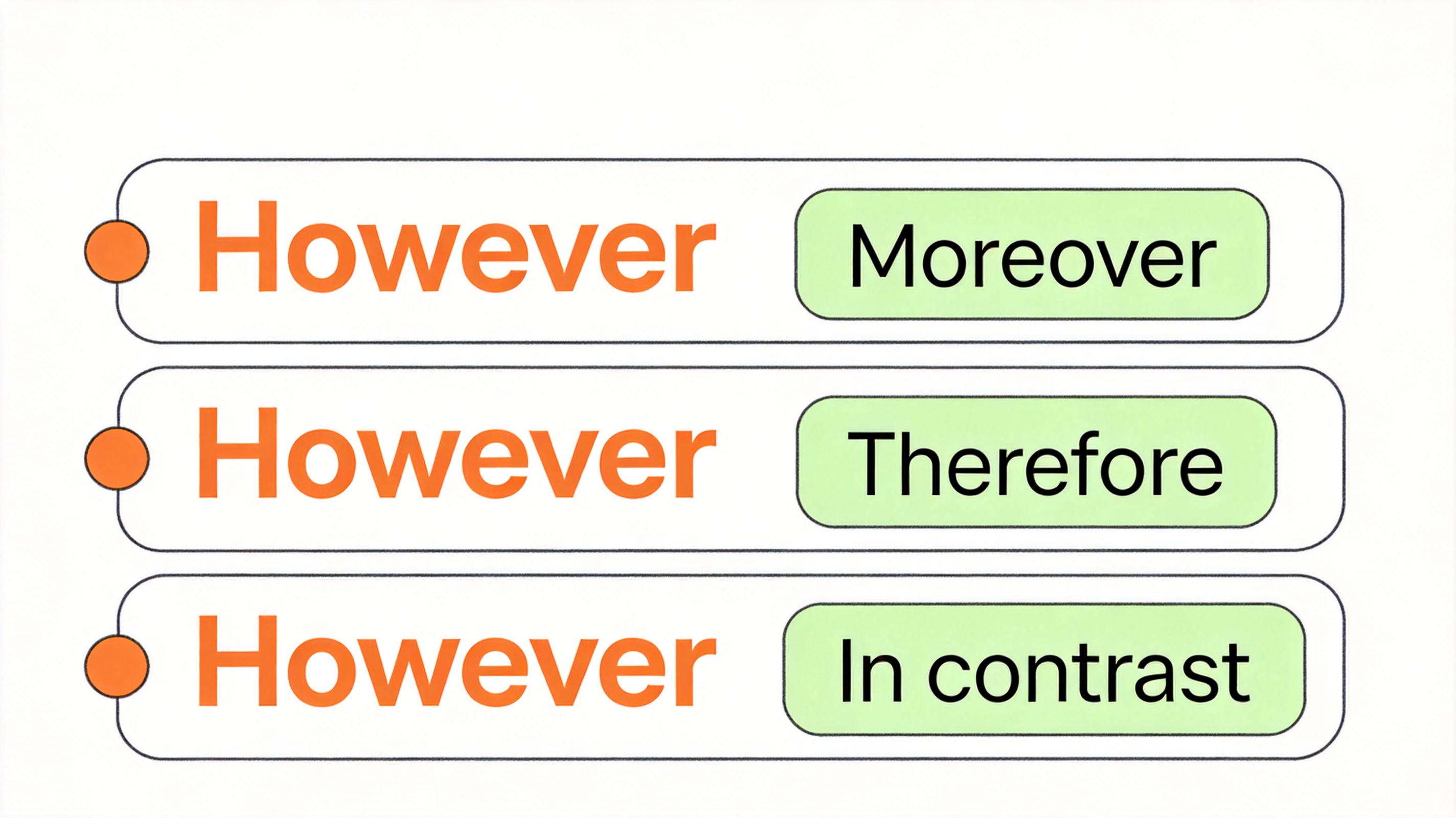
Overusing the same transition word
The Best Free Alternative: WPS Office
Once your transition words are in place, the writing and formatting stage matters just as much. WPS Office gives you a free Writer with grammar-style polish, clean paragraph styling, and built-in WPS AI that can suggest smoother connections between ideas — useful when you want to vary transitions without breaking your voice. Students use it for everything from a 1,000-word essay to a full essay rewriter workflow, and the AI essay writer guide shows how to draft and revise responsibly.
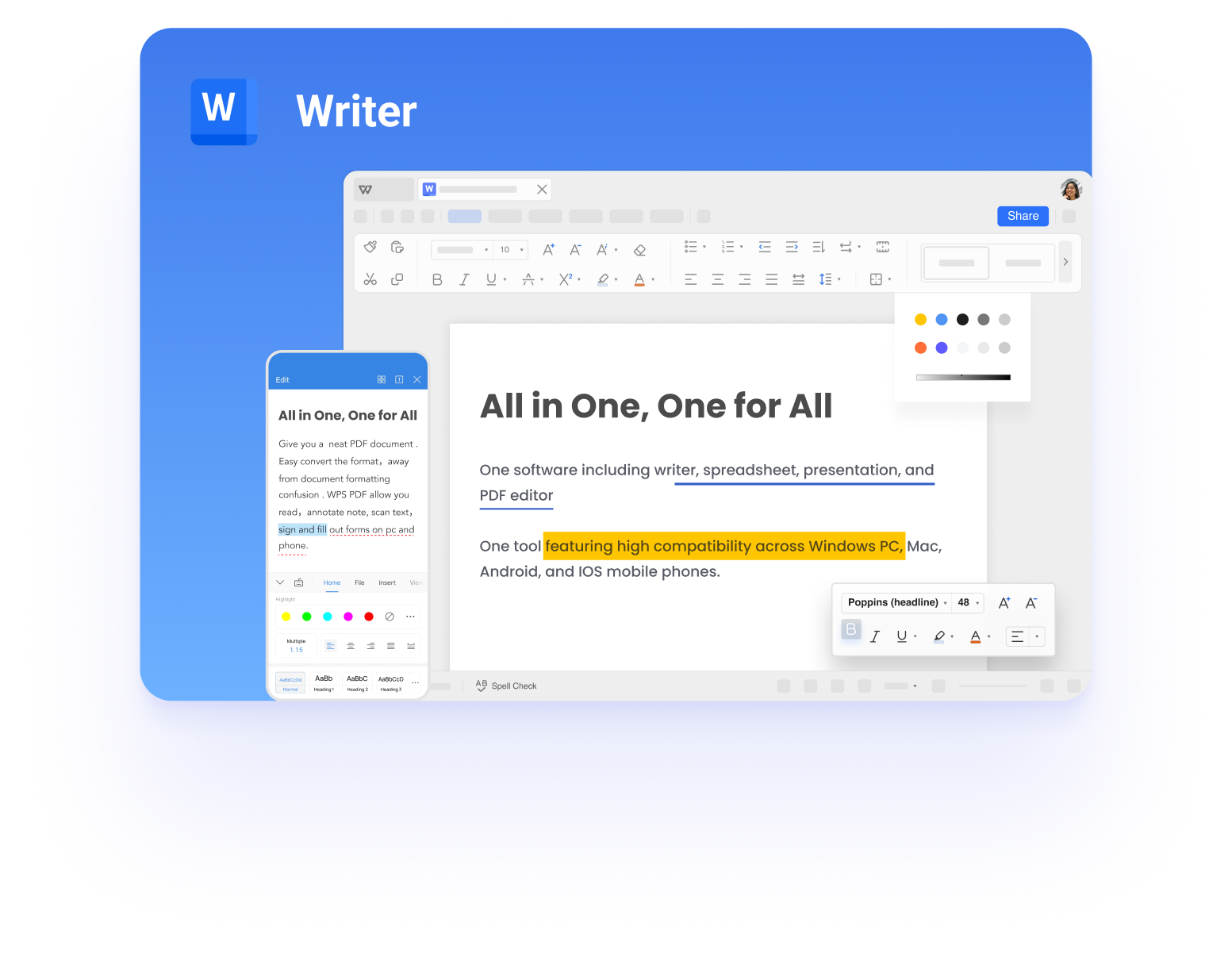
WPS Writer editing an essay
FAQs
1. What are transition words for paragraphs?
They are words and phrases — however, moreover, therefore, in conclusion — that show how a new paragraph relates to the previous one, making an essay read as one connected argument instead of separate blocks.
2. How many transition words should I use per page?
One transition per paragraph opening is usually enough, plus occasional mid-sentence connectors. A page with more than five or six transitions starts to feel mechanical.
3. Can I start a paragraph with "And" or "But"?
Yes. "But" works like a lighter "however" and "And" like a lighter "moreover". Many style guides accept them, though formal academic writing often prefers the fuller transitions from the list above.
4. Do transition words go at the beginning or the middle of a sentence?
Both are correct. Single-word transitions (However, Therefore) usually open the sentence and take a comma; longer phrases (in contrast, as a result) can also sit mid-sentence after the subject.
5. What is the difference between transition words and conjunctions?
Conjunctions (and, but, because) join clauses inside one sentence. Transition words link sentences and paragraphs and are normally followed by a comma when they open a sentence.

'%3e%3cpath%20d='M19.9911%204.11386V6.471H18.5894C18.0775%206.471%2017.7322%206.57814%2017.5536%206.79243C17.3751%207.00671%2017.2858%207.32814%2017.2858%207.75671V9.44421H19.9019L19.5536%2012.0871H17.2858V18.8639H14.5536V12.0871H12.2769V9.44421H14.5536V7.49779C14.5536%206.39064%2014.8632%205.53201%2015.4822%204.92189C16.1013%204.31177%2016.9257%204.00671%2017.9554%204.00671C18.8304%204.00671%2019.509%204.04243%2019.9911%204.11386Z'%20fill='%23333333'/%3e%3c/g%3e%3cdefs%3e%3cclipPath%20id='clip0_2938_8199'%3e%3crect%20width='16'%20height='16'%20fill='white'%20transform='translate(8%204.00671)'/%3e%3c/clipPath%3e%3c/defs%3e%3c/svg%3e)
'%3e%3cpath%20d='M17.5237%2010.7813L23.4811%204H22.0699L16.8949%209.88693L12.7648%204H8L14.2469%2012.9029L8%2020.0133H9.4112L14.8725%2013.7952L19.2352%2020.0133H24M9.92053%205.04213H12.0885L22.0688%2019.0224H19.9003'%20fill='%23333333'/%3e%3c/g%3e%3cdefs%3e%3cclipPath%20id='clip0_2938_8200'%3e%3crect%20width='16'%20height='16.0134'%20fill='white'%20transform='translate(8%204)'/%3e%3c/clipPath%3e%3c/defs%3e%3c/svg%3e)


