

'%3e%3cpath%20d='M8%200C12.4183%200%2016%203.58172%2016%208C16%2012.4183%2012.4183%2016%208%2016C3.58172%2016%200%2012.4183%200%208C0%203.58172%203.58172%200%208%200ZM11.6162%204.38379C11.2257%203.99337%2010.5927%203.99338%2010.2021%204.38379L8%206.58594L5.79785%204.38379C5.40732%203.99334%204.77429%203.99329%204.38379%204.38379C3.99331%204.77429%203.99335%205.40733%204.38379%205.79785L6.58594%208L4.38379%2010.2021C3.99348%2010.5927%203.99341%2011.2257%204.38379%2011.6162C4.77426%2012.0066%205.40734%2012.0065%205.79785%2011.6162L8%209.41406L10.2021%2011.6162C10.5927%2012.0066%2011.2257%2012.0067%2011.6162%2011.6162C12.0067%2011.2257%2012.0066%2010.5927%2011.6162%2010.2021L9.41406%208L11.6162%205.79785C12.0066%205.40735%2012.0066%204.77429%2011.6162%204.38379Z'%20fill='%23080E17'%20fill-opacity='0.46'/%3e%3c/g%3e%3cdefs%3e%3cclipPath%20id='clip0_3761_713'%3e%3crect%20width='16'%20height='16'%20fill='white'/%3e%3c/clipPath%3e%3c/defs%3e%3c/svg%3e)



'%3e%3cpath%20fill-rule='evenodd'%20clip-rule='evenodd'%20d='M21.4999%2010.9993C21.4999%205.20009%2016.7986%200.498901%2010.9993%200.498901C5.19994%200.498901%200.498657%205.20009%200.498657%2010.9993C0.498657%2016.2404%204.33858%2020.5844%209.35855%2021.3722V14.0346H6.69238V10.9993H9.35855V8.68594C9.35855%206.05427%2010.9262%204.60062%2013.3248%204.60062C14.4736%204.60062%2015.6753%204.80571%2015.6753%204.80571V7.38979H14.3512C13.0468%207.38979%2012.64%208.19921%2012.64%209.0296V10.9993H15.5523L15.0867%2014.0346H12.64V21.3722C17.66%2020.5844%2021.4999%2016.2404%2021.4999%2010.9993Z'%20fill='%231568EA'/%3e%3c/g%3e%3c/svg%3e)


'%3e%3cpath%20d='M2.42045%2022.1876H6.31818V12.7217L0.75%208.54553V20.5171C0.75%2021.4414%201.49892%2022.1876%202.42045%2022.1876Z'%20fill='%234285F4'/%3e%3cpath%20d='M19.682%2022.1876H23.5797C24.5041%2022.1876%2025.2502%2021.4387%2025.2502%2020.5171V8.54553L19.682%2012.7217'%20fill='%2334A853'/%3e%3cpath%20d='M19.682%205.48293V12.7216L25.2502%208.54543V6.31816C25.2502%204.25236%2022.8921%203.07469%2021.2411%204.31361'%20fill='%23FBBC04'/%3e%3cpath%20d='M6.31824%2012.7217V5.48303L13.0001%2010.4944L19.6819%205.48303V12.7217L13.0001%2017.733'%20fill='%23EA4335'/%3e%3cpath%20d='M0.75%206.31816V8.54543L6.31818%2012.7216V5.48293L4.75909%204.31361C3.10534%203.07469%200.75%204.25236%200.75%206.31816Z'%20fill='%23C5221F'/%3e%3c/g%3e%3cdefs%3e%3cclipPath%20id='clip0_2954_7305'%3e%3crect%20width='24.5'%20height='18.375'%20fill='white'%20transform='translate(0.75%203.8125)'/%3e%3c/clipPath%3e%3c/defs%3e%3c/svg%3e)


A partnership usually starts before anyone signs a contract. Two companies agree to explore a joint project, a nonprofit and a city agency decide to share resources, or a supplier and a distributor test a new market together. Before the lawyers get involved, the parties write down what they intend to do. That document is a memorandum of understanding (MOU).
This guide explains what an MOU is, what it should contain, and how to write one step by step. You will also see when an MOU can become legally binding, how it differs from a contract, and how to draft and export one in WPS Office using a free layout.
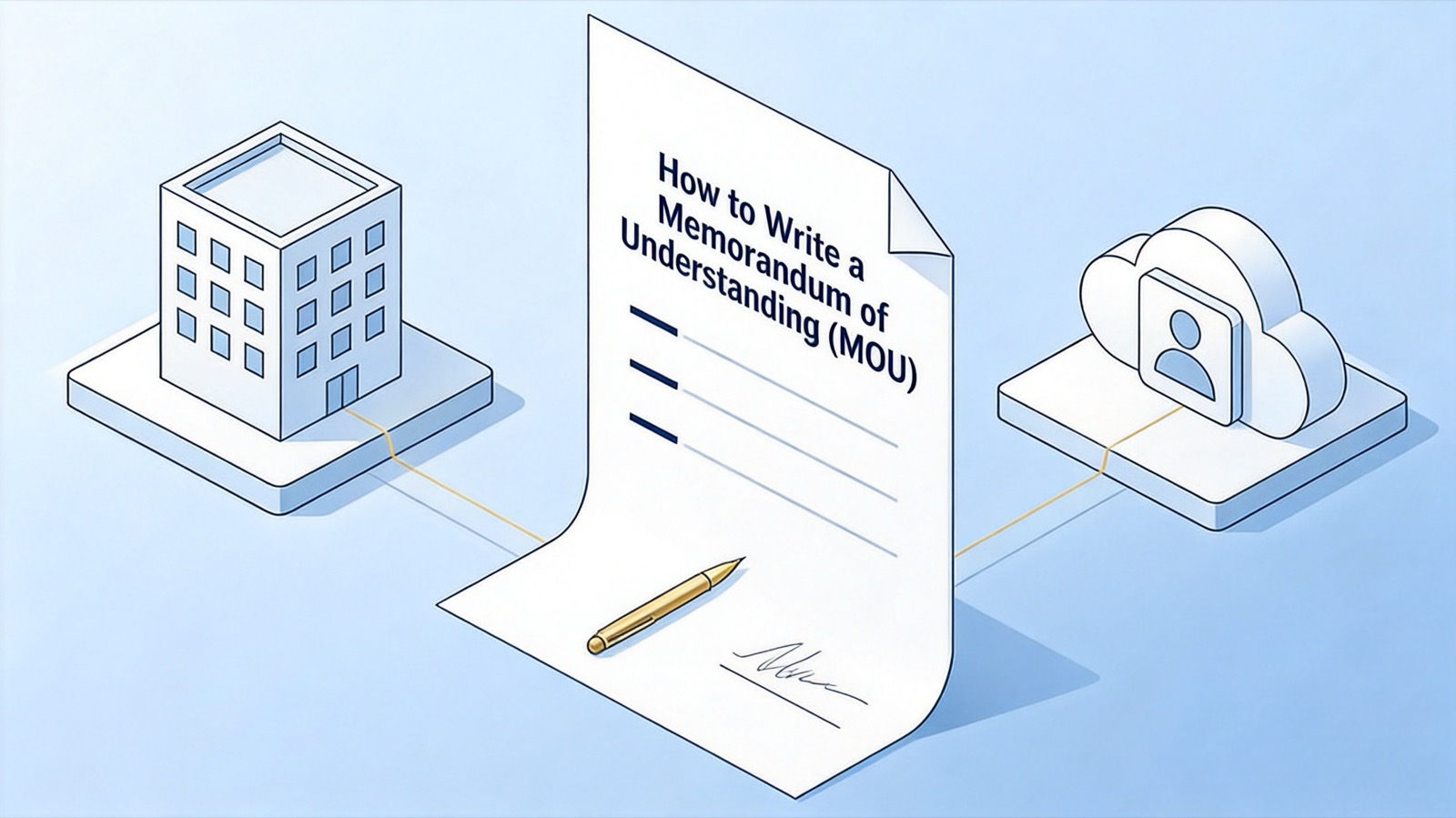
How to Write a Memorandum of Understanding (MOU)
What is a memorandum of understanding (MOU)?
A memorandum of understanding (MOU) is a written agreement between two or more parties that records how they plan to work together toward a shared goal. It is usually non-binding: it describes intent, expectations, and responsibilities without creating enforceable obligations.
Because it is not a contract, an MOU is most often used at the start of a relationship, while the details of a formal agreement are still being negotiated. In practice it does three jobs: it puts the shared goal in writing, it makes each side's role explicit, and it gives both parties something concrete to review before they commit to a binding deal.
You may also see an MOU called a letter of intent (LOI) or a memorandum of agreement (MOA). The three overlap, and in many settings the names are used almost interchangeably, but they are not identical everywhere — if the label matters for your project, check the convention in your country and industry.
An MOU is the wrong tool when money changes hands or when you are ready to be legally bound. Non-financial collaboration, early-stage partnerships, joint research, and public-sector cooperation are typical MOU territory; a purchase, a paid service, or a lease belongs in a contract.
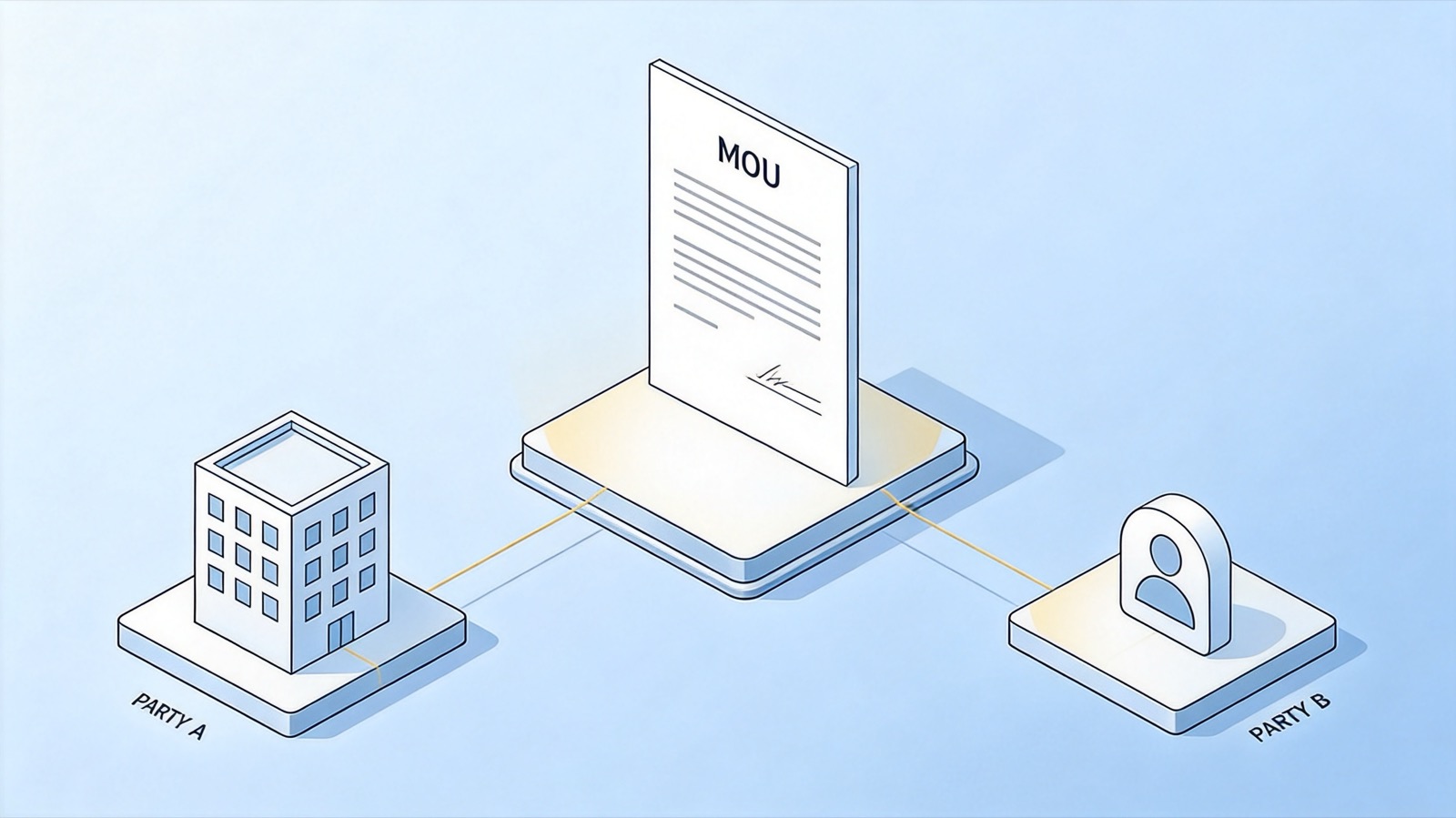
MOU agreement between two parties


What should an MOU include?
There is no single mandatory format, but a workable MOU covers the same core ground every time. Keep each section short and specific — a vague MOU tends to create the disagreements it was meant to prevent.
Parties. The full legal name of every organization or individual involved, and the role each one plays.
Purpose and background. Why the MOU exists and what the parties want to achieve together.
Scope and objectives. The activities included in the collaboration, and just as useful, what is explicitly out of scope.
Roles and responsibilities. Who contributes what: staff time, data, facilities, funding, or expertise.
Timeline. The start date, the milestones, and how long the understanding is meant to last.
Confidentiality and data handling. What information is shared, with whom, and how long it stays protected.
Dispute resolution and termination. How disagreements are handled and how either party can exit.
Signature block. Names, titles, and dates for the authorized representative of each party.
Two habits make the document more useful. Define the terms you rely on — "pilot phase," "shared data," "partner" — instead of leaving them to interpretation. And keep the language plain: an MOU both sides can read in ten minutes is far more likely to be followed than one that sounds impressive.
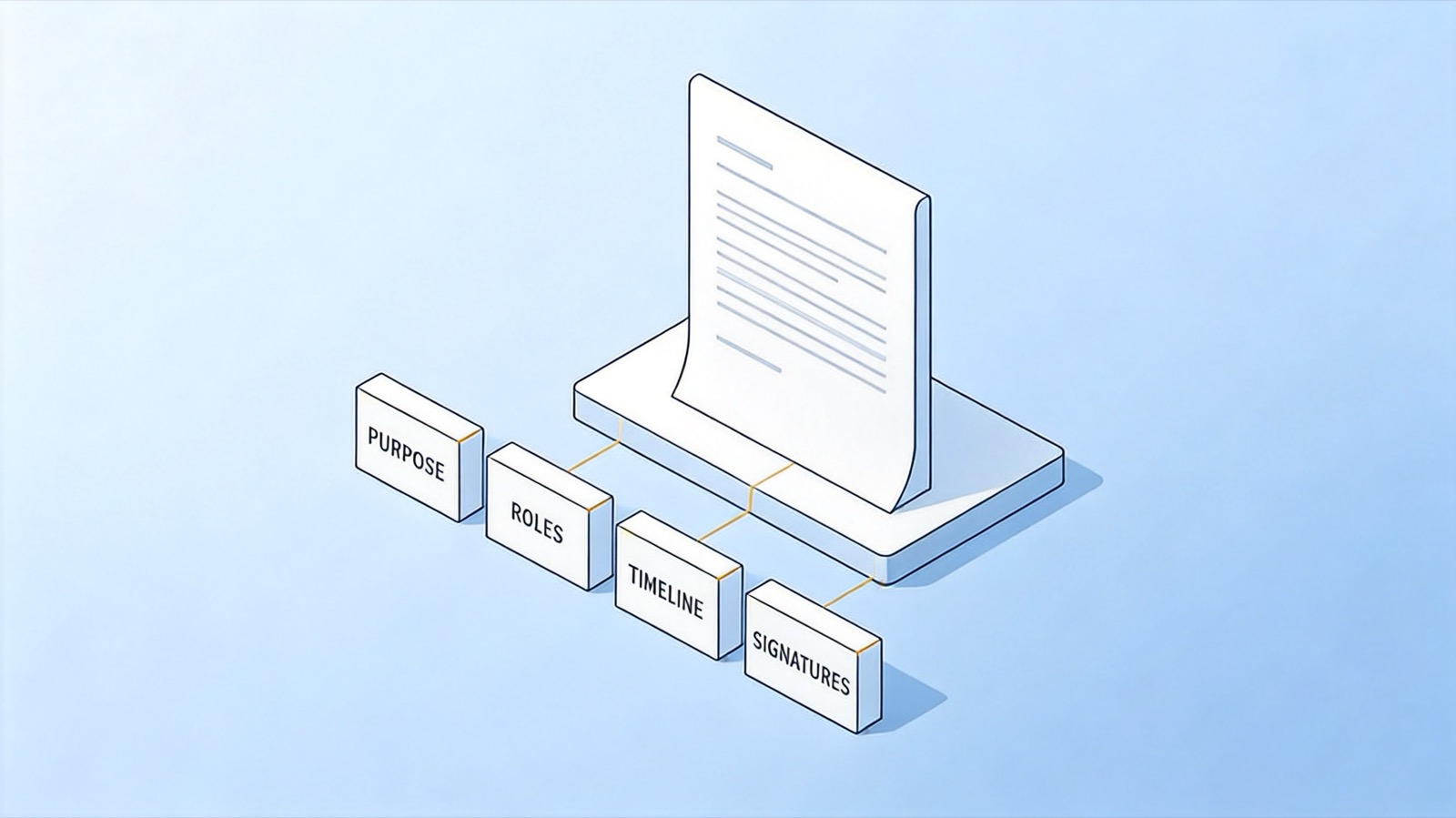
Key sections every MOU should include
How to write an MOU step by step
You can draft a complete MOU in an afternoon. Work through the steps below in order, and start from a template so the structure is already in place.
Start from a template or a clean document. Open WPS Writer, search the template library for "memorandum of understanding", or begin with a blank document and add the section headings from the list above.
Write the title, the parties, and the effective date. Label the document "Memorandum of Understanding", state the date it takes effect, and give each party's full legal name and address on first mention.
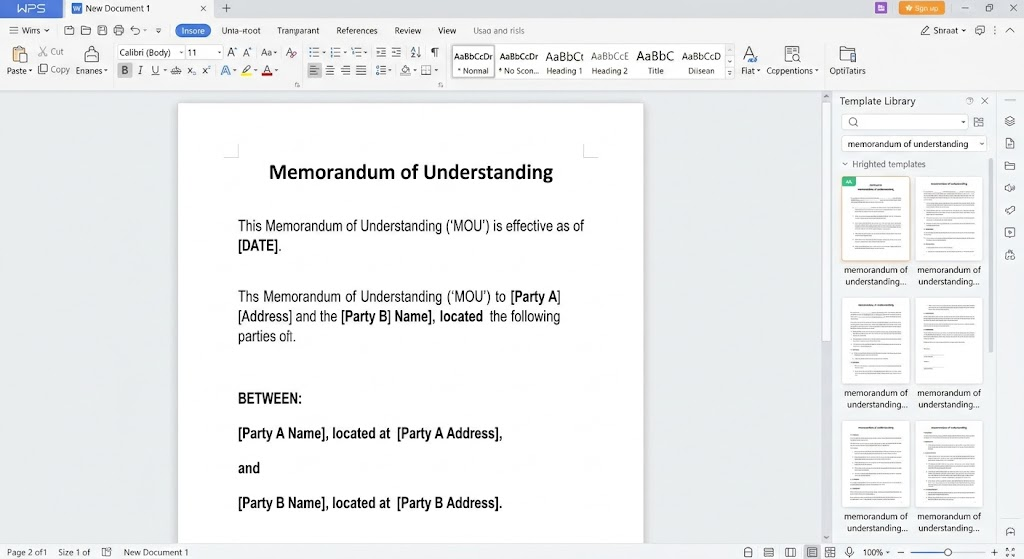
Describe the purpose and background. Two or three sentences are enough: what the parties want to achieve and why they are working together now.
Set the scope and objectives. List the specific activities that are in scope, then add a short paragraph naming the exclusions.
Assign roles and responsibilities. Give every party at least one concrete responsibility, and name a contact person for each side so questions do not stall.
Add the timeline. State the term, the milestones, and what happens if a milestone slips. Dates keep a non-binding document moving.
Cover confidentiality, termination, and disputes. Say what information stays confidential, how much notice either party must give to withdraw, and how a disagreement gets resolved.
Review, sign, and share the final copy. Read the draft once for ambiguity and once for accuracy, then export a PDF so the layout is identical for everyone.
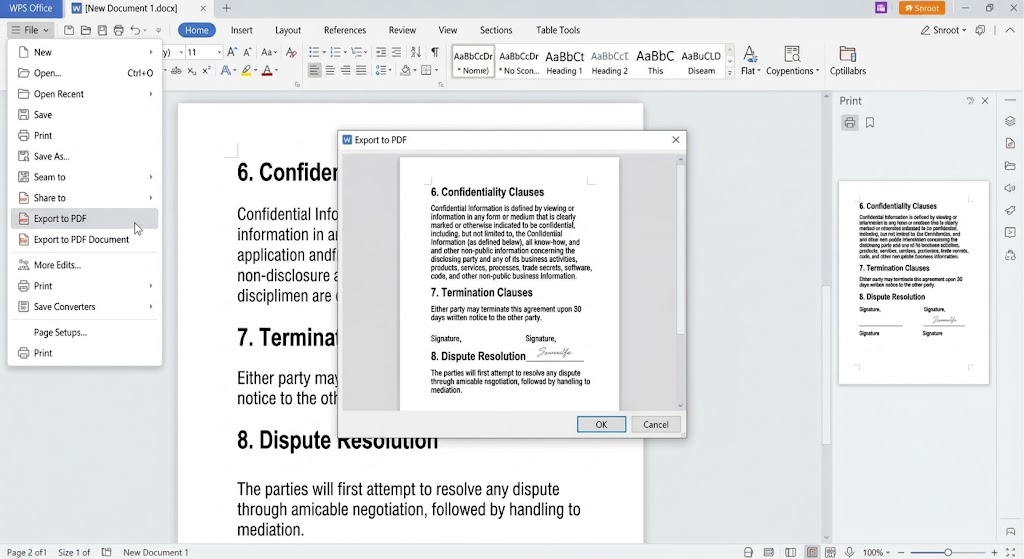
WPS Writer MOU draft editing example
Is an MOU legally binding?
Usually not. Before a court treats an agreement as an enforceable contract, it generally looks for four elements: an offer, acceptance of that offer, an intention to be legally bound, and consideration — something of value that each side exchanges. A typical MOU contains none of the last two, which is exactly why it stays non-binding.
That said, the label on the document is not decisive. Courts read the four corners of the text and the circumstances around it. If your MOU promises to pay, to deliver goods, or to be "binding and enforceable", it can be treated as a contract no matter what the title says. Wording such as "the parties intend to be legally bound" is what turns stated intent into obligation.
If you want a clearly non-binding MOU, say so in the document: add a sentence stating that it records intent only and creates no legal obligations. If your project involves payments, intellectual property, liability, or parties in different countries, ask a qualified lawyer to review the draft before anyone signs. Rules vary by jurisdiction, and this article is general information rather than legal advice.
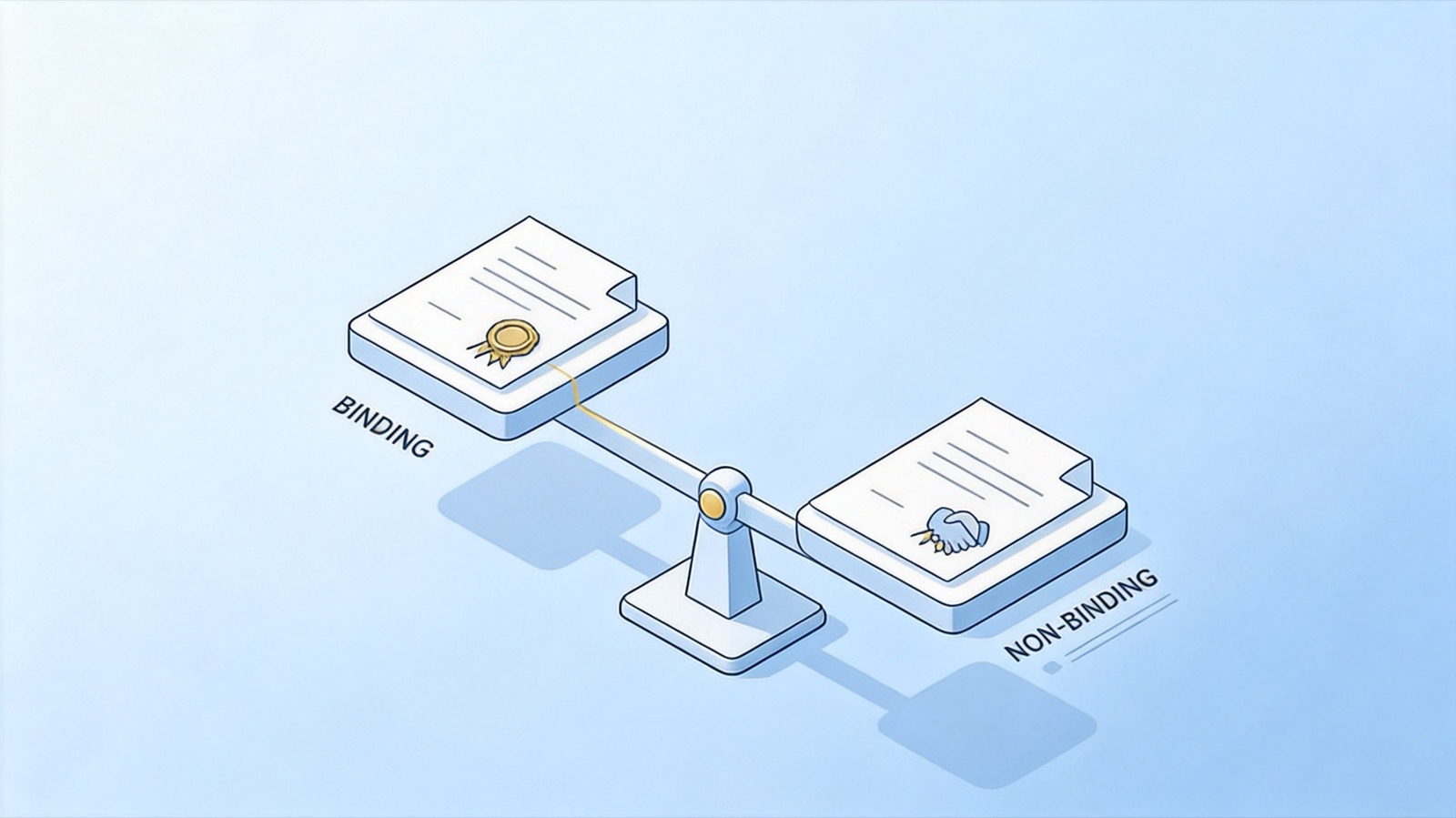
Binding and non-binding MOU agreement
MOU vs MOA vs contract: what is the difference?
The three documents sit on the same path from first conversation to signed deal, at different levels of detail and legal weight.
| Document | What it does | When to use it |
|---|---|---|
| MOU | Records shared intent, scope, and roles; broad and usually non-binding | Early discussions, exploratory partnerships, non-financial collaboration |
| MOA | Adds specific responsibilities and commitments; may or may not be binding | When the parties agree on how the work will be organized but not yet on formal terms |
| Contract | Creates enforceable rights and obligations, with something of value exchanged | When payment, deliverables, deadlines, liability, or remedies must be enforceable |
In practice, a project often moves from MOU to MOA to contract, and each document adds detail. If you already know you will need a binding agreement, start there and read every provision carefully — our guide to contract clauses covers the wording that most often changes what each side actually owes.
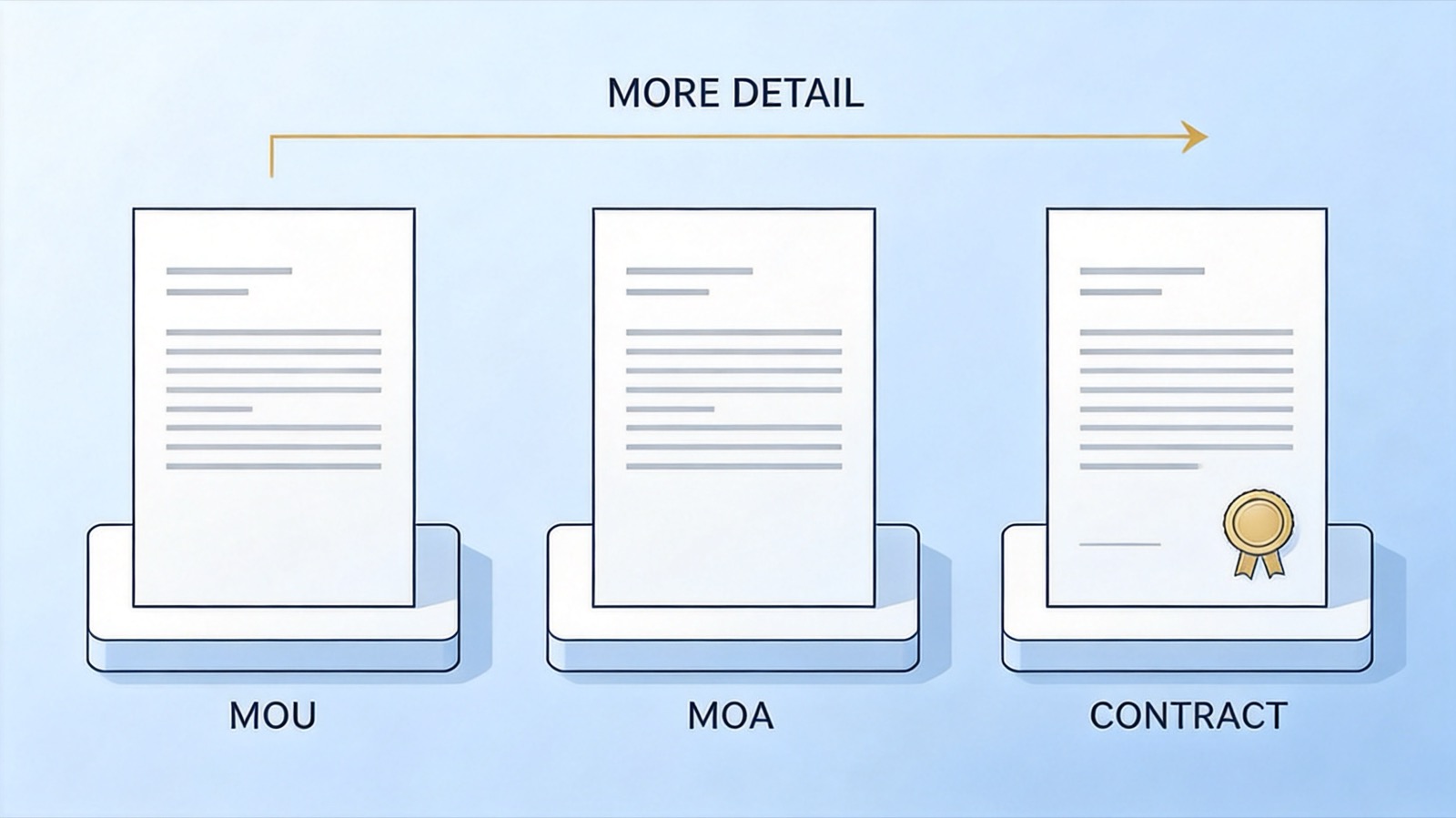
MOU MOA and contract comparison
The Best Free Alternative: WPS Office for writing an MOU
You do not need paid software to produce a clean, signable MOU. WPS Office opens and saves Microsoft Word documents without layout drift, so a template stays intact while you replace the placeholders with your own terms.
Free layouts and templates. Browse the built-in library at WPS templates for business and legal documents, or start from a blank page and format the headings once.
Write and refine with WPS AI. Draft a section from a short prompt, shorten a wordy paragraph, or ask for a plainer version of dense wording, then keep only the parts that match your arrangement.
Export a stable PDF. Use Menu > Export to PDF so the signature-ready version looks identical on every device, and keep the editable document as your master copy.
The working file matters here. Keep the editable MOU as your master, send the PDF for review and signature, and export a fresh PDF after every change so nobody signs a stale page.
Related reading: if a collaboration ends, a contract termination letter template covers the notice; if your MOU appoints someone to act for a party, an authorization letter template handles that separate document; and for the messages that surround the deal, see how to write a formal letter.
WPS Office free all-in-one office suite
FAQs
What does MOU stand for?
MOU stands for memorandum of understanding. It is a written document in which two or more parties record how they intend to work together toward a shared goal. It is normally non-binding and is used before a formal contract is drafted.
Is an MOU legally binding?
Usually not. An MOU becomes enforceable only if it contains the elements of a contract — an offer, acceptance, an intention to be legally bound, and consideration — or language that says it is binding. If you want your MOU to stay non-binding, state that clearly in the document and have anything high-risk reviewed by a lawyer.
What is the difference between an MOU and a contract?
An MOU records intent and expectations and is generally not enforceable. A contract creates enforceable rights and obligations and involves something of value exchanged by each party. Use an MOU while you negotiate; sign a contract when you are ready to be held to the terms.
How long should an MOU be?
Most MOUs run one to three pages — enough to cover the parties, purpose, scope, responsibilities, timeline, confidentiality, and the signature block, without the detail of a contract. If your MOU keeps growing, that is usually a sign you are ready to move to a binding agreement.
Can I write an MOU myself?
Yes, for a straightforward non-binding collaboration you can draft one yourself from a template and adjust the sections to your project. Bring in a qualified lawyer if the arrangement involves payments, intellectual property, liability, regulated industries, or parties in different countries.


'%3e%3cpath%20d='M19.9911%204.11386V6.471H18.5894C18.0775%206.471%2017.7322%206.57814%2017.5536%206.79243C17.3751%207.00671%2017.2858%207.32814%2017.2858%207.75671V9.44421H19.9019L19.5536%2012.0871H17.2858V18.8639H14.5536V12.0871H12.2769V9.44421H14.5536V7.49779C14.5536%206.39064%2014.8632%205.53201%2015.4822%204.92189C16.1013%204.31177%2016.9257%204.00671%2017.9554%204.00671C18.8304%204.00671%2019.509%204.04243%2019.9911%204.11386Z'%20fill='%23333333'/%3e%3c/g%3e%3cdefs%3e%3cclipPath%20id='clip0_2938_8199'%3e%3crect%20width='16'%20height='16'%20fill='white'%20transform='translate(8%204.00671)'/%3e%3c/clipPath%3e%3c/defs%3e%3c/svg%3e)
'%3e%3cpath%20d='M17.5237%2010.7813L23.4811%204H22.0699L16.8949%209.88693L12.7648%204H8L14.2469%2012.9029L8%2020.0133H9.4112L14.8725%2013.7952L19.2352%2020.0133H24M9.92053%205.04213H12.0885L22.0688%2019.0224H19.9003'%20fill='%23333333'/%3e%3c/g%3e%3cdefs%3e%3cclipPath%20id='clip0_2938_8200'%3e%3crect%20width='16'%20height='16.0134'%20fill='white'%20transform='translate(8%204)'/%3e%3c/clipPath%3e%3c/defs%3e%3c/svg%3e)


