

'%3e%3cpath%20d='M8%200C12.4183%200%2016%203.58172%2016%208C16%2012.4183%2012.4183%2016%208%2016C3.58172%2016%200%2012.4183%200%208C0%203.58172%203.58172%200%208%200ZM11.6162%204.38379C11.2257%203.99337%2010.5927%203.99338%2010.2021%204.38379L8%206.58594L5.79785%204.38379C5.40732%203.99334%204.77429%203.99329%204.38379%204.38379C3.99331%204.77429%203.99335%205.40733%204.38379%205.79785L6.58594%208L4.38379%2010.2021C3.99348%2010.5927%203.99341%2011.2257%204.38379%2011.6162C4.77426%2012.0066%205.40734%2012.0065%205.79785%2011.6162L8%209.41406L10.2021%2011.6162C10.5927%2012.0066%2011.2257%2012.0067%2011.6162%2011.6162C12.0067%2011.2257%2012.0066%2010.5927%2011.6162%2010.2021L9.41406%208L11.6162%205.79785C12.0066%205.40735%2012.0066%204.77429%2011.6162%204.38379Z'%20fill='%23080E17'%20fill-opacity='0.46'/%3e%3c/g%3e%3cdefs%3e%3cclipPath%20id='clip0_3761_713'%3e%3crect%20width='16'%20height='16'%20fill='white'/%3e%3c/clipPath%3e%3c/defs%3e%3c/svg%3e)



'%3e%3cpath%20fill-rule='evenodd'%20clip-rule='evenodd'%20d='M21.4999%2010.9993C21.4999%205.20009%2016.7986%200.498901%2010.9993%200.498901C5.19994%200.498901%200.498657%205.20009%200.498657%2010.9993C0.498657%2016.2404%204.33858%2020.5844%209.35855%2021.3722V14.0346H6.69238V10.9993H9.35855V8.68594C9.35855%206.05427%2010.9262%204.60062%2013.3248%204.60062C14.4736%204.60062%2015.6753%204.80571%2015.6753%204.80571V7.38979H14.3512C13.0468%207.38979%2012.64%208.19921%2012.64%209.0296V10.9993H15.5523L15.0867%2014.0346H12.64V21.3722C17.66%2020.5844%2021.4999%2016.2404%2021.4999%2010.9993Z'%20fill='%231568EA'/%3e%3c/g%3e%3c/svg%3e)


'%3e%3cpath%20d='M2.42045%2022.1876H6.31818V12.7217L0.75%208.54553V20.5171C0.75%2021.4414%201.49892%2022.1876%202.42045%2022.1876Z'%20fill='%234285F4'/%3e%3cpath%20d='M19.682%2022.1876H23.5797C24.5041%2022.1876%2025.2502%2021.4387%2025.2502%2020.5171V8.54553L19.682%2012.7217'%20fill='%2334A853'/%3e%3cpath%20d='M19.682%205.48293V12.7216L25.2502%208.54543V6.31816C25.2502%204.25236%2022.8921%203.07469%2021.2411%204.31361'%20fill='%23FBBC04'/%3e%3cpath%20d='M6.31824%2012.7217V5.48303L13.0001%2010.4944L19.6819%205.48303V12.7217L13.0001%2017.733'%20fill='%23EA4335'/%3e%3cpath%20d='M0.75%206.31816V8.54543L6.31818%2012.7216V5.48293L4.75909%204.31361C3.10534%203.07469%200.75%204.25236%200.75%206.31816Z'%20fill='%23C5221F'/%3e%3c/g%3e%3cdefs%3e%3cclipPath%20id='clip0_2954_7305'%3e%3crect%20width='24.5'%20height='18.375'%20fill='white'%20transform='translate(0.75%203.8125)'/%3e%3c/clipPath%3e%3c/defs%3e%3c/svg%3e)


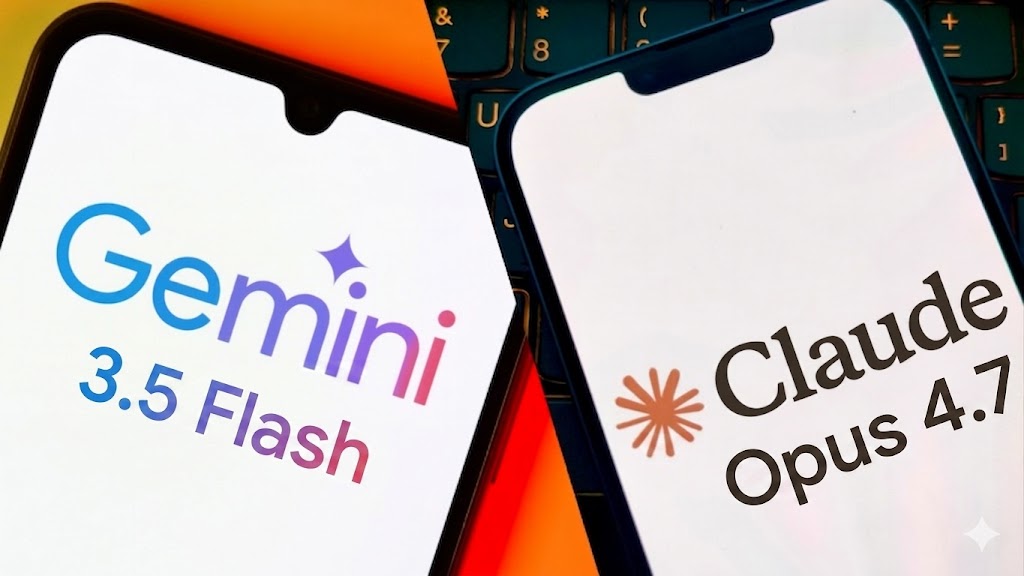
Two new AI frontrunners have entered the arena—but you only need to pick one membership. Google’s Gemini 3.5 Flash, unveiled at Google I/O 2026, positions itself as a fast, affordable frontier model, while Anthropic’s Claude Opus 4.7, released just a month earlier in April 2026, doubles down on coding prowess and reasoning depth.
This is not about declaring a single “winner.” It is about matching the right tool to the right job. Across benchmarks, real world tasks, and cost metrics, the verdict is clear: Gemini 3.5 Flash offers better value for everyday users, while Opus 4.7 remains the choice for professional creators.
Let’s dive into the data.
Quick Specs & Benchmark Scorecard
Before we test these models on real tasks, here’s a side by side look at how they compare across standard benchmarks.
Data Sources & Clarifications
Gemini 3.5 Flash’s benchmark data comes primarily from Google’s internal testing and early independent evaluations. On Terminal Bench 2.1, it achieved 76.2%—outpacing both its predecessor Gemini 3.1 Pro (70.3%) and Claude Opus 4.7 (66.1%). On MCP Atlas, it scored 83.6%, leading the same peer group.
For Claude Opus 4.7, the official numbers stand out: SWE bench Verified at 87.6%, up from Opus 4.6’s 80.8%; SWE bench Pro at 64.3%, a nearly 11 point leap over Opus 4.5’s 53.4%; and a staggering 75.8% on ARC AGI 2, compared to Opus 4.5’s 37.6%—a +38.2 point increase. On GPQA Diamond, Opus 4.7 scored 94.2%, outperforming Opus 4.5’s 87.3% by 7.2 points.
Real World Experience – Three Critical Tests
Numbers on a chart only tell part of the story. Here’s how these models behave when put to real world tasks.
Coding: Build a simple todo app
Prompt: “Write a working HTML/CSS/JS to do list with local storage.”
Opus 4.7 is widely recognized as the gold standard for serious software engineering tasks. On SWE bench Pro, Opus 4.7 achieved 64.3%—significantly ahead of GPT 5.4 (57.7%) and Gemini 3.1 Pro (54.2%). Developers working on complex, multi file codebases consistently favor Opus for its structural elegance, robust error handling, and self verification patterns—it has been known to write mathematical proofs before touching system level code.
Gemini 3.5 Flash, meanwhile, prioritizes throughput. On Terminal Bench 2.1—an agentic coding benchmark focused on real terminal environments—Gemini 3.5 Flash scored 76.2%, outperforming both Gemini 3.1 Pro (70.3%) and Opus 4.7 (66.1%). For quick prototypes, bug squashing, and tasks where iteration speed matters more than architectural perfection, Gemini’s efficiency wins.
Bottom line: For production ready code → Opus 4.7. For quick prototypes → Gemini 3.5 Flash.
Creative writing: “Write a 200 word scifi scene about a lonely AI.”
While Anthropic does not publish creative writing benchmarks, the qualitative difference between these models is well documented. Opus 4.7’s reasoning depth—evident in its 94.2% GPQA Diamond score—translates into richer narrative flow, unexpected metaphors, and tonal nuance. Professional writers and content creators consistently report that Opus 4.7 requires fewer rewrites for long form narrative work.
Gemini 3.5 Flash, by contrast, excels at speed and structure. It delivers logically coherent, grammatically sound output in seconds—but the prose can feel mechanical and lacks the stylistic polish of Opus.
Bottom line: For polished creative writing → Opus 4.7.
Logic trap / trick question
Prompt: “A bat and a ball cost 1.10intotal.Thebatcosts1.10intotal.Thebatcosts1.00 more than the ball. How much is the ball?”
This classic cognitive reflection test (the intuitive but incorrect answer is “10 cents”) is trivial for both models. Neither falls for the trap; both correctly compute that the ball costs 5 cents and the bat costs $1.05.
Bottom line: Tie—both handle standard logic problems without difficulty.
Strengths & Weaknesses – At a Glance
On a 14-step MCP tool chain, Gemini 3.5 Flash finished in 11.3 seconds at a cost of 0.018 USD, compared to Opus 4.7 at 38.9 seconds and 0.061 USD. Gemini is therefore about four times faster and 3.4 times cheaper per run. For high-volume tasks, these savings add up quickly. Opus 4.7 also introduces a practical reliability feature: when data is incomplete or uncertain, it refuses to answer rather than fabricating plausible but incorrect responses. This matters enormously for serious decision making.
A quick note on Opus 4.7’s tokenizer: Anthropic introduced a new tokenizer that maps the same text to roughly 1.0–1.35× as many tokens as Opus 4.6, depending on content. Combined with Opus 4.7’s tendency to engage in deeper reasoning (“thinking longer”) on complex tasks, actual token consumption will likely rise. Budget accordingly if you plan heavy use.
Final Verdict – Two User Profiles
“Gemini 3.5 Flash for everyday users; Opus 4.7 for professional creators.”
For casual and everyday users
(Students, office workers, general AI enthusiasts, startup builders on a budget)
Choose Gemini 3.5 Flash:
· Cost advantage: At roughly one third the price of Opus 4.7, Gemini 3.5 Flash delivers ~97% of the benchmark performance for 36% of the price.
· Speed advantage: 4x faster output speeds and near instant latency transform daily workflows.
· Multimodal native: Vision, audio, video, and text—all in one model, no workarounds.
· Ample context: 1M tokens handle entire codebases or hundreds of pages of documentation.
Gemini covers 90% of everyday tasks—chat, summarization, translation, coding assistance, quick drafts—exceptionally well, for far less money and in far less time.
For professional creators
(Writers, software engineers, researchers, content strategists, enterprises)
Choose Claude Opus 4.7:
· Coding dominance: Industry leading SWE bench Verified (87.6%) and Pro (64.3%) scores outperform all competitors.
· Writing polish: Better narrative flow and stylistic nuance require fewer rewrites for published content.
· Reasoning depth: 94.2% on GPQA Diamond and 75.8% on ARC AGI 2 reflect genuinely deeper problem solving.
· Reliability culture: Refuses to answer when uncertain rather than fabricating plausible but false information.
· Visual understanding: Handles high resolution images up to 2,576 pixels on the long edge.
For mission critical outputs—production code, published articles, research analysis—Opus 4.7’s higher price buys real quality and peace of mind.
If budget allows both
Use Gemini 3.5 Flash for daily Q&A, rapid prototyping, and high throughput tasks. Reserve Opus 4.7 for final draft polishing, complex debugging, and work where quality cannot be compromised.
Optimize Your Workflow: Bring AI into Your Documents with WPS Office
While choosing the right AI model is the first step in maximizing your productivity, integrating these powerful AI capabilities directly into your daily document workflow is the logical next step.
For those who rely on Gemini 3.5 Flash for rapid drafting or Claude Opus 4.7 for polished, professional output, WPS Office serves as the perfect environment to house your work.
Seamless Integration: Use your generated content to create stunning presentations, professional reports, or complex data sheets without leaving your workspace.
AI-Enhanced Productivity: WPS Office complements your AI strategy by providing a streamlined, all-in-one suite that handles your final outputs with the same efficiency you expect from your AI models.
Ready for Any Task: Whether you are a student organizing notes or a professional managing a complex project, WPS Office provides the stability and formatting power to ensure your AI-generated insights look as good as they sound.
Take your productivity to the next level. Download WPS Office today to unify your AI-generated drafts with a powerful, versatile document management suite.
What do you think—which model are you leaning toward, and how do you plan to use it with your daily office tools? Drop a comment below


'%3e%3cpath%20d='M19.9911%204.11386V6.471H18.5894C18.0775%206.471%2017.7322%206.57814%2017.5536%206.79243C17.3751%207.00671%2017.2858%207.32814%2017.2858%207.75671V9.44421H19.9019L19.5536%2012.0871H17.2858V18.8639H14.5536V12.0871H12.2769V9.44421H14.5536V7.49779C14.5536%206.39064%2014.8632%205.53201%2015.4822%204.92189C16.1013%204.31177%2016.9257%204.00671%2017.9554%204.00671C18.8304%204.00671%2019.509%204.04243%2019.9911%204.11386Z'%20fill='%23333333'/%3e%3c/g%3e%3cdefs%3e%3cclipPath%20id='clip0_2938_8199'%3e%3crect%20width='16'%20height='16'%20fill='white'%20transform='translate(8%204.00671)'/%3e%3c/clipPath%3e%3c/defs%3e%3c/svg%3e)
'%3e%3cpath%20d='M17.5237%2010.7813L23.4811%204H22.0699L16.8949%209.88693L12.7648%204H8L14.2469%2012.9029L8%2020.0133H9.4112L14.8725%2013.7952L19.2352%2020.0133H24M9.92053%205.04213H12.0885L22.0688%2019.0224H19.9003'%20fill='%23333333'/%3e%3c/g%3e%3cdefs%3e%3cclipPath%20id='clip0_2938_8200'%3e%3crect%20width='16'%20height='16.0134'%20fill='white'%20transform='translate(8%204)'/%3e%3c/clipPath%3e%3c/defs%3e%3c/svg%3e)


