

A recruiter gives your resume a few seconds on the first pass, so the number of bullet points per job decides what actually gets read. Pack in ten bullets and the strongest achievements drown; use none and your impact hides inside dense paragraphs.
This guide gives you the exact range to aim for, how to shift it by career level, and a simple formula so every line earns its place.
How Many Bullet Points Per Job on a Resume? A Simple Guide
How Many Bullet Points Per Job on a Resume? The Quick Answer
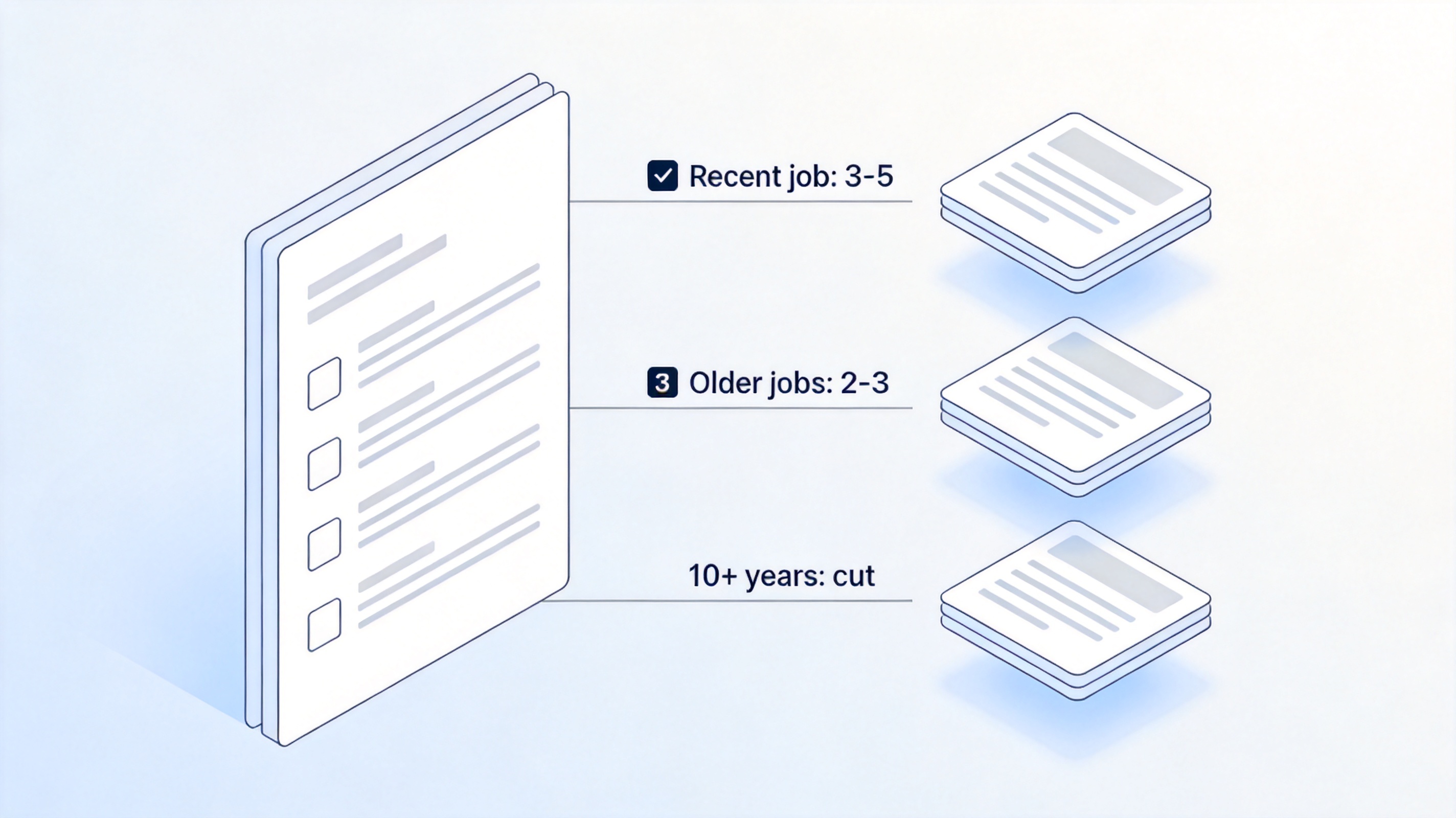
The working range is 3–5 bullet points per job, weighted toward your most recent and most relevant roles. Hiring managers skim before they read, and the first three or four bullets under each position get most of the attention, so anything past five or six per job stops adding information and starts adding noise.
Most recent job: 4–6 bullets, leading with your strongest, most quantified wins.
Jobs from the last 5–10 years: 3–4 bullets each, focused on what maps to the target role.
Older or short stints: 2–3 bullets, or a single summary line if they no longer support your direction.
Roles older than about 15 years: cut the bullets and keep one line with title, company, and dates.
If the same duty appears under two positions, describe it once where it mattered most and drop the duplicate. Depth on your latest role plus restraint on older ones keeps the page balanced at a glance.
Ideal bullet points per job on resume


Why Bullet Points Matter to Recruiters
Bullet points exist because of how resumes are actually read. Eye-tracking studies such as the well-known Ladders research found that recruiters spend roughly six to seven seconds on an initial scan, moving between your job titles, dates, and a handful of bullet lines — not paragraphs.
Three things happen when the count is right:
Scanning gets easier. Short parallel lines let a recruiter find scope and results without decoding sentences.
Your best evidence surfaces. With only 3–5 slots per job, you are forced to keep metrics and cut filler duties.
ATS parsing stays clean. Simple bulleted structure with standard characters reads reliably in applicant tracking systems; heavily nested symbols or text boxes can garble it. For a full optimization pass, see this guide on how to create an ATS resume with a 90+ score.
Paragraph-style job descriptions fail this scan: the reader has to hunt for outcomes inside walls of text, and most give up before finding them.

Recruiter scanning resume in six seconds
How to Tailor Bullet Points to Each Job on Your Resume
The right count shifts with seniority and relevance. Use the position's importance to the role you want next — not the calendar alone — to decide how many lines it deserves.
Rank your roles by relevance. Put the jobs closest to the target role at the top of your attention budget, whatever their dates.
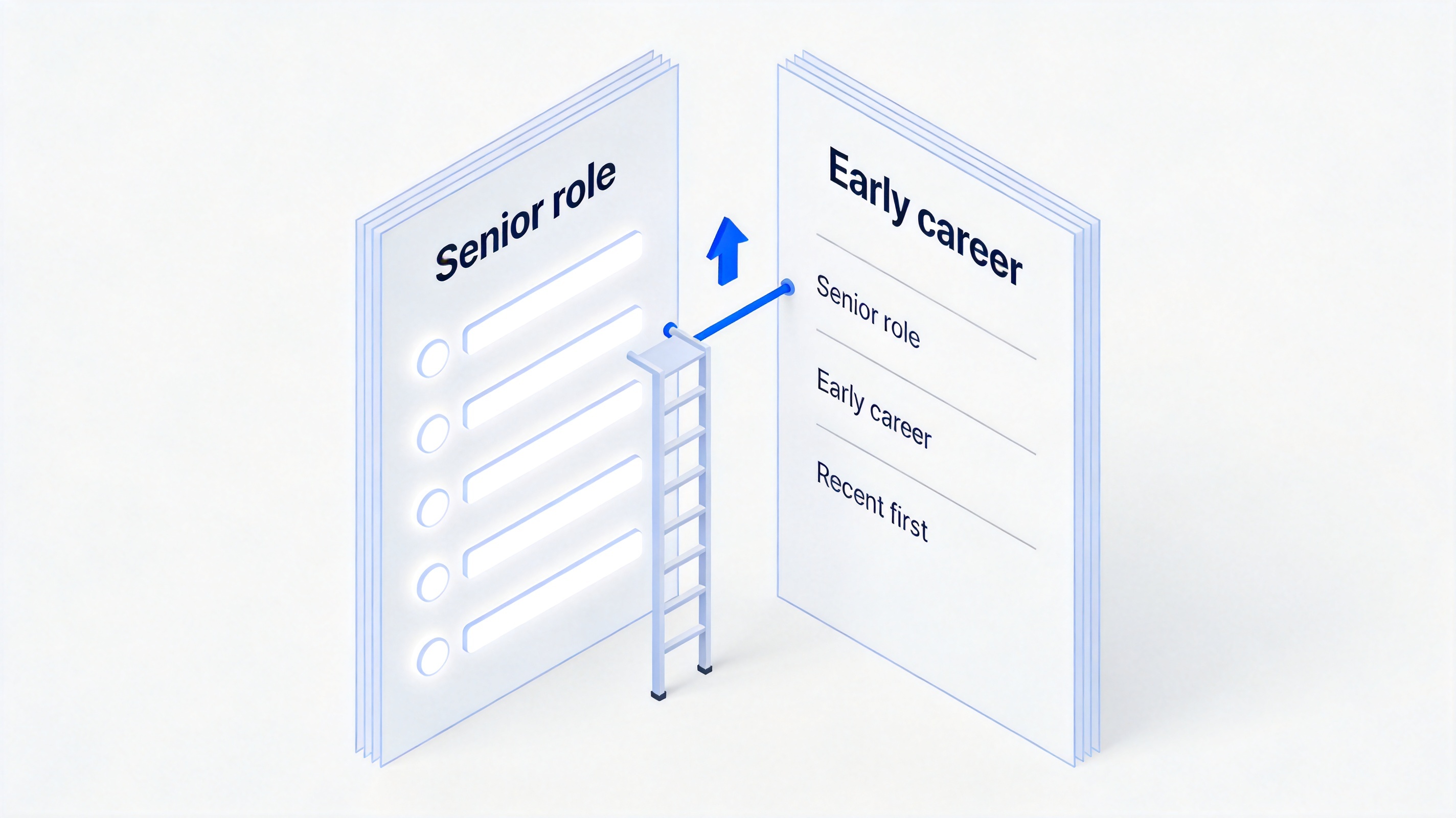
Give the most recent role 4–6 bullets. This is the position a recruiter assumes describes you today, so let it carry your strongest numbers.
Trim mid-career roles to 3–4 bullets. Keep the achievements that still differentiate you; delete duties that are implied by your senior titles.
Compress early-career roles to 2–3 bullets. One line each for internships and student jobs is enough once you have solid experience above them.
Adjust for level, not just age. Entry-level candidates can spend more bullets on projects and part-time work; senior candidates replace bullets with a promotion line, such as "Promoted to manager within 14 months."
Bullets per job by career level
How to Write Resume Bullet Points That Get Results
Counting bullets only works when each one is dense with evidence. A reliable formula is: action verb + what you did + scale or number + result. Not every bullet needs all four parts, but every bullet needs at least a verb and an outcome.
Start with a strong action verb. Replace "Responsible for" and "Helped with" with verbs like led, grew, cut, launched, automated, or negotiated.
Name the tool or method. "Built SQL dashboards" tells more than "worked with data," and it feeds keyword matching in ATS filters.
Attach a number. Percentages, dollar amounts, team sizes, volumes, and time frames all work — approximate figures are fine if honest.
Close with the result. Say what changed because you did the work: churn down, revenue up, hours saved, errors eliminated.
Match the tense. Present tense for your current job, past tense for everything earlier, and one line per bullet with no wrapping beyond two lines.
For example, "Owned a portfolio of 40 enterprise accounts ($12M ARR), reducing churn from 9% to 4% in 12 months" beats "Managed customer relationships" in every way that matters: it proves scope, action, and outcome in one line.
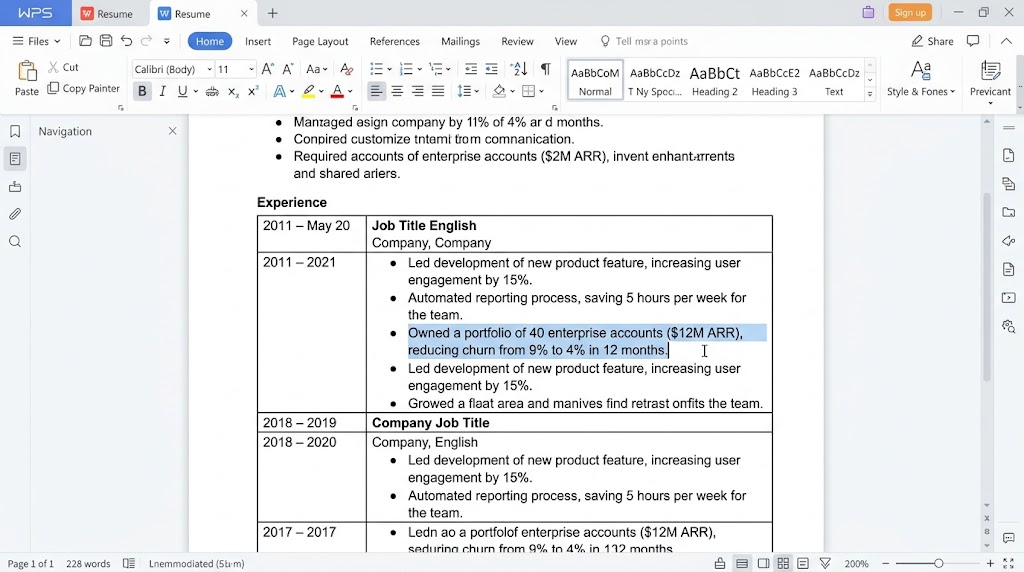
Editing resume bullet points in WPS Writer
Common Mistakes With Bullet Points on a Resume
Most bullet problems come from two extremes: too many lines, or lines with no substance. Watch for these patterns when you edit:
Seven or more bullets per job. Past the sixth line, older bullets stop being read; merge or delete instead of trimming font size.
Duty lists with no results. "Answered phones and emails" describes presence, not performance — add what improved because you did it.
Repeating the job description. Copying the posting word for word adds no evidence; mirror its keywords only where you can prove them.
Walls of text in disguise. A "bullet" that wraps four lines is a paragraph; cut it to one or two lines with a number.
Inconsistent formatting. Mixing periods, capitalization, and bullet symbols across sections looks careless at a glance — pick one style and apply it everywhere.
Burying numbers mid-line. Recruiters catch figures near the start of a bullet more reliably than at the end.
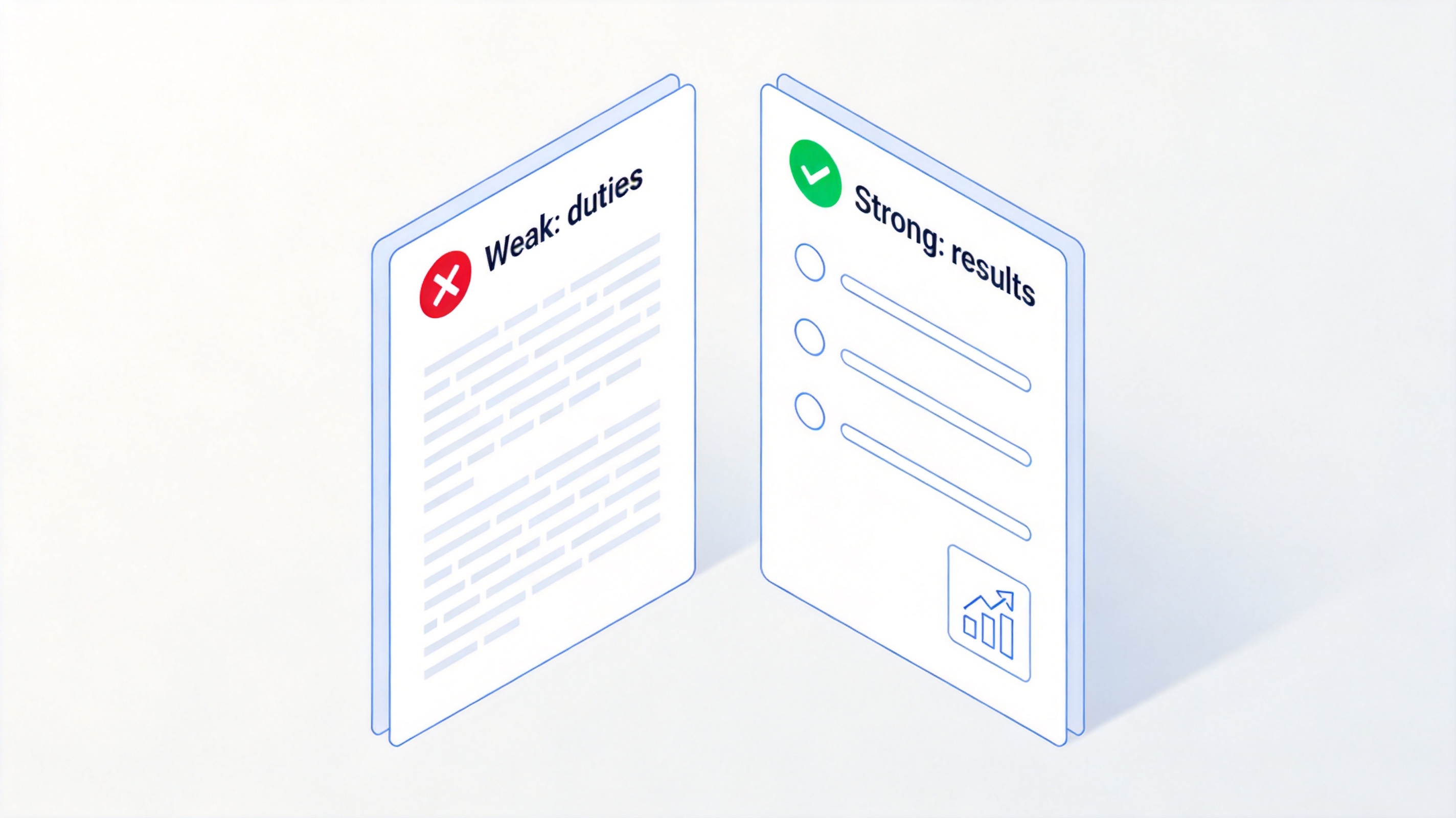
Weak duties versus strong results bullets
The Best Free Alternative: WPS Office for Resume Writing
Getting the bullet count right is a writing problem, but it is also a formatting problem: bullets that wrap unevenly, misaligned dates, or a two-page sprawl undo good writing. A free word processor with proper resume templates solves that without a subscription, and WPS Writer covers the whole workflow.
WPS Writer works on Windows, macOS, Linux, iOS, and Android, opens and saves .docx with high fidelity, and includes a library of ready-made resume templates where the work-experience section is already structured for 3–5 clean bullets per job. Here is the end-to-end process:
Start from a template. Open WPS Writer, go to the built-in template library, and filter for "Resume" — pick a single-page layout that matches your industry.
Fill in the header and skills first. Add your name, contact details, and a short skills block so the experience section has a clear frame.
Paste one achievement per bullet. Under each job, add 3–5 bullets using the action verb + number + result formula from the previous section; delete the template's placeholder lines you do not need.
Tighten the formatting. Keep each bullet to one or two lines, use one bullet symbol throughout, and confirm the whole document still fits one page.
Export a fixed PDF. Use the built-in PDF export so spacing and bullets stay identical on every recruiter's screen. For template ideas, browse these free PDF resume templates with writing tips.
The practical difference against paid resume builders is simple: no paywall when you need a last-minute edit, no watermark on export, and the same file opens in Word on the recruiter's side without layout drift. If you also keep notes, references, or a portfolio index alongside your applications, the same suite gives you Word, Excel, and PowerPoint compatible tools in one free download.
WPS Writer
FAQs
How many bullet points per job on a resume if I have 10+ years of experience?
Give your two or three most recent roles 4–6 bullets each and compress everything older to 2–3. Roles beyond roughly 15 years need only a one-line entry with title, company, and dates.
Is 2 bullet points enough for a job on a resume?
Yes, for older, short, or less relevant positions. Two dense, quantified bullets beat six vague ones. Keep 3–5 only for the roles that directly support the job you are applying to.
How many bullet points should a resume have in total?
For most one-page resumes, roughly 12–20 bullets across all roles works well: 4–6 for the current job and 2–4 for each earlier position, plus a few for projects or education if you are early in your career.
Should older jobs have fewer bullet points than recent ones?
Yes. Recruiters weigh your last 10 years most heavily, so the bullet budget should shrink as roles get older. This keeps the page short and points attention at your current level of responsibility.
How long should each resume bullet point be?
One to two lines each, ideally under about 25 words. Lead with the action verb, keep the number close to the front, and cut any phrase that does not add scale or outcome.