


An analytical essay grades your argument, not your opinion, and most students lose marks because they summarize instead of analyze. This guide gives you the structure, a working outline, and a model body paragraph to follow.
How to Write an Analytical Essay: Structure, Outline, and Example
How to Write an Analytical Essay: The Structure
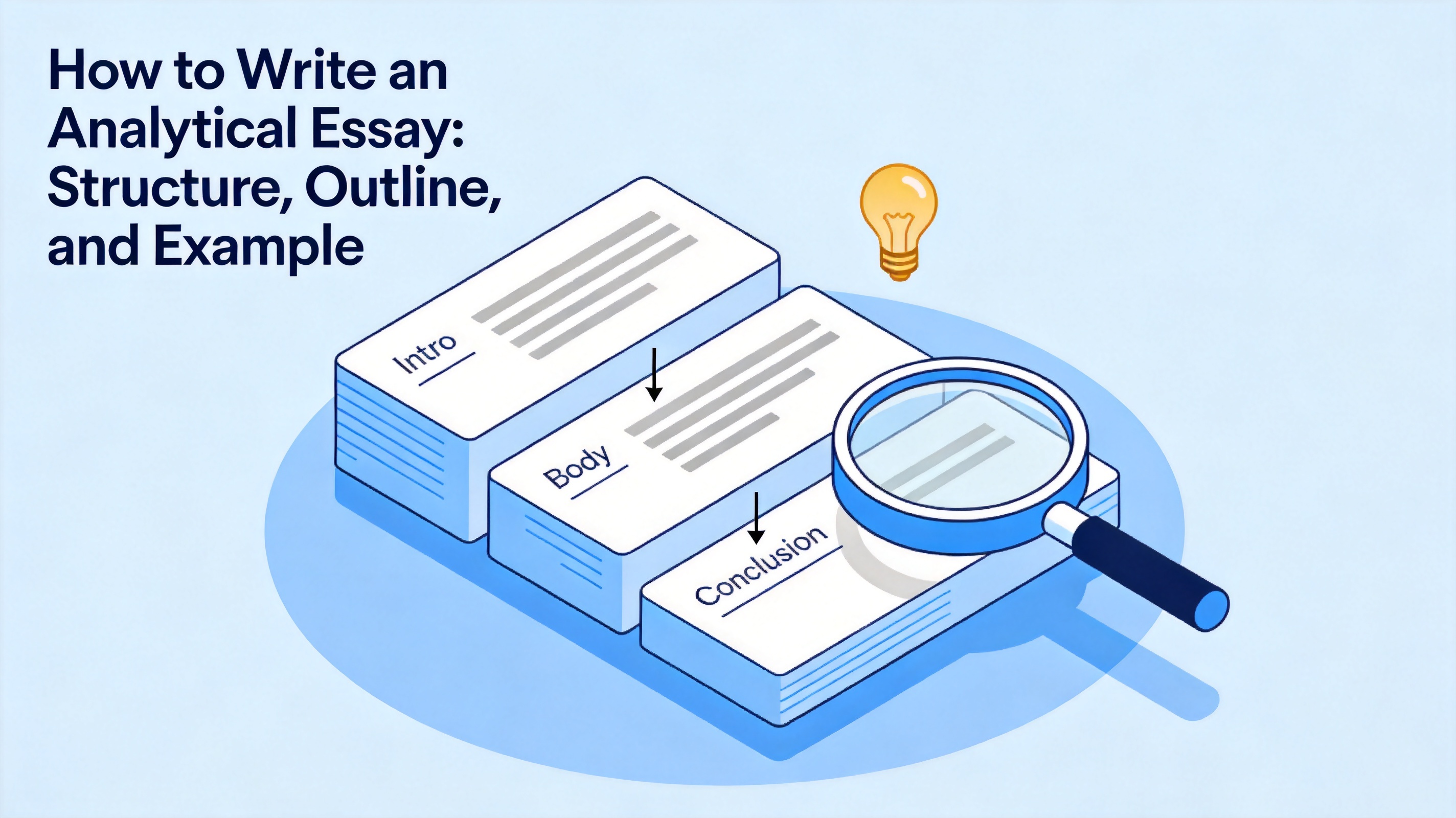
An analytical essay breaks a text, film, or idea into parts and explains how those parts work together. Its structure is fixed: an introduction with a clear thesis, body paragraphs that each prove one point with evidence, and a conclusion that pulls the analysis together.
Open with context and a specific, arguable thesis.
Build body paragraphs that each make one claim backed by evidence.
Close with a conclusion that explains the wider meaning, not a repeat.

Analytical essay structure introduction body conclusion


Build the Analytical Essay Outline
Outline before you write, so every paragraph earns its place. Start with the thesis, list the three or four points that support it, and pair each point with the exact evidence you will quote or cite.
Write the thesis in one sentence that states your reading of the work.
List a supporting point and its evidence for each body paragraph.
Order the points so each paragraph builds on the one before it.

Analytical essay outline thesis and evidence
Analytical Essay Example: How a Body Paragraph Works
A strong body paragraph makes a claim, quotes the evidence, and then explains why that evidence supports the claim — it does not just retell the story. Keep the quote short and spend most of the paragraph on your analysis.
Open the paragraph with your point about the work.
Quote or cite one specific piece of evidence.
Explain what the evidence reveals and why it matters.
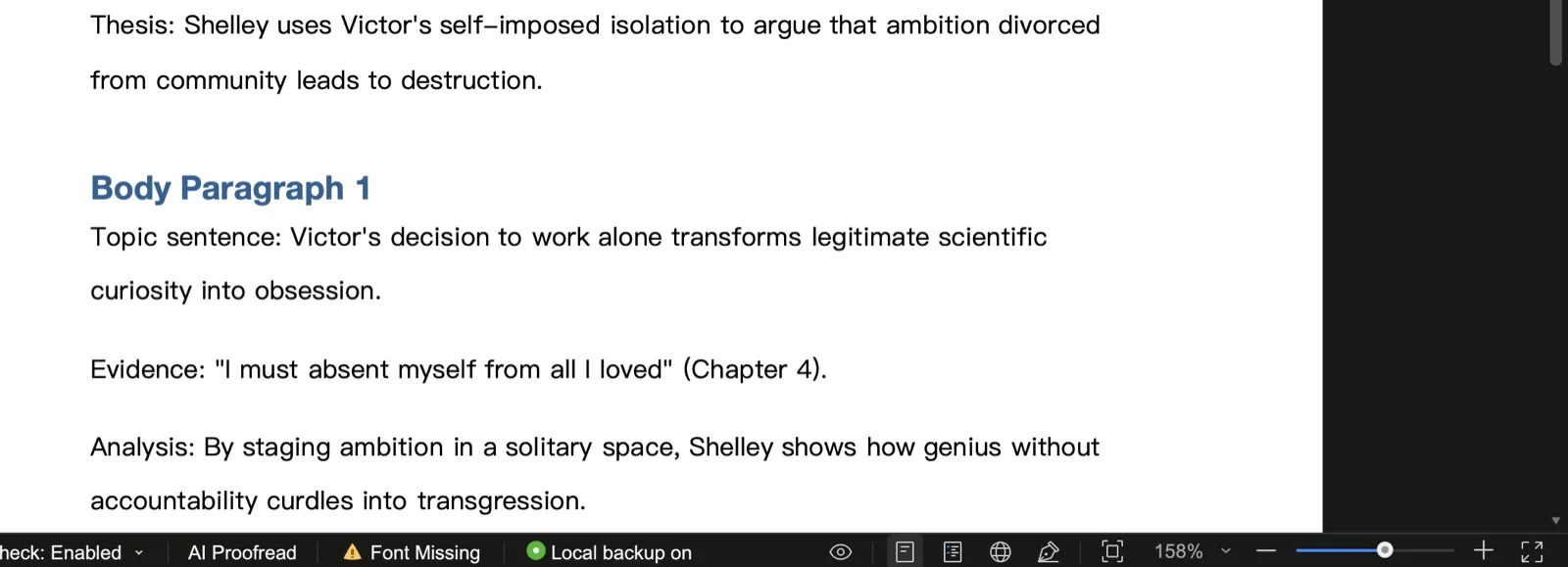
Analytical essay body paragraph example
Write and Format the Analytical Essay Free in WPS Writer
WPS Writer is a free place to draft, outline, and format your analytical essay, with built-in styles for headings and citations and PDF export for clean submission. Keep the outline beside the draft so every body paragraph stays tied to your thesis.
| What you need | WPS Writer | Dedicated essay apps |
|---|---|---|
| Draft and outline | Free, in one place | Monthly plan |
| Headings and citations | Built-in styles | Often limited |
| Submission format | PDF and Word export | Limited export |
| Work anywhere | Desktop and mobile | App-dependent |
Outline next to draft: keep the thesis and evidence list open as you write each paragraph.
Clean formatting: use heading styles and export to PDF so your essay looks exactly as required.
Free for students: no subscription to format one assignment. See related tips on writing a persuasive essay step by step.
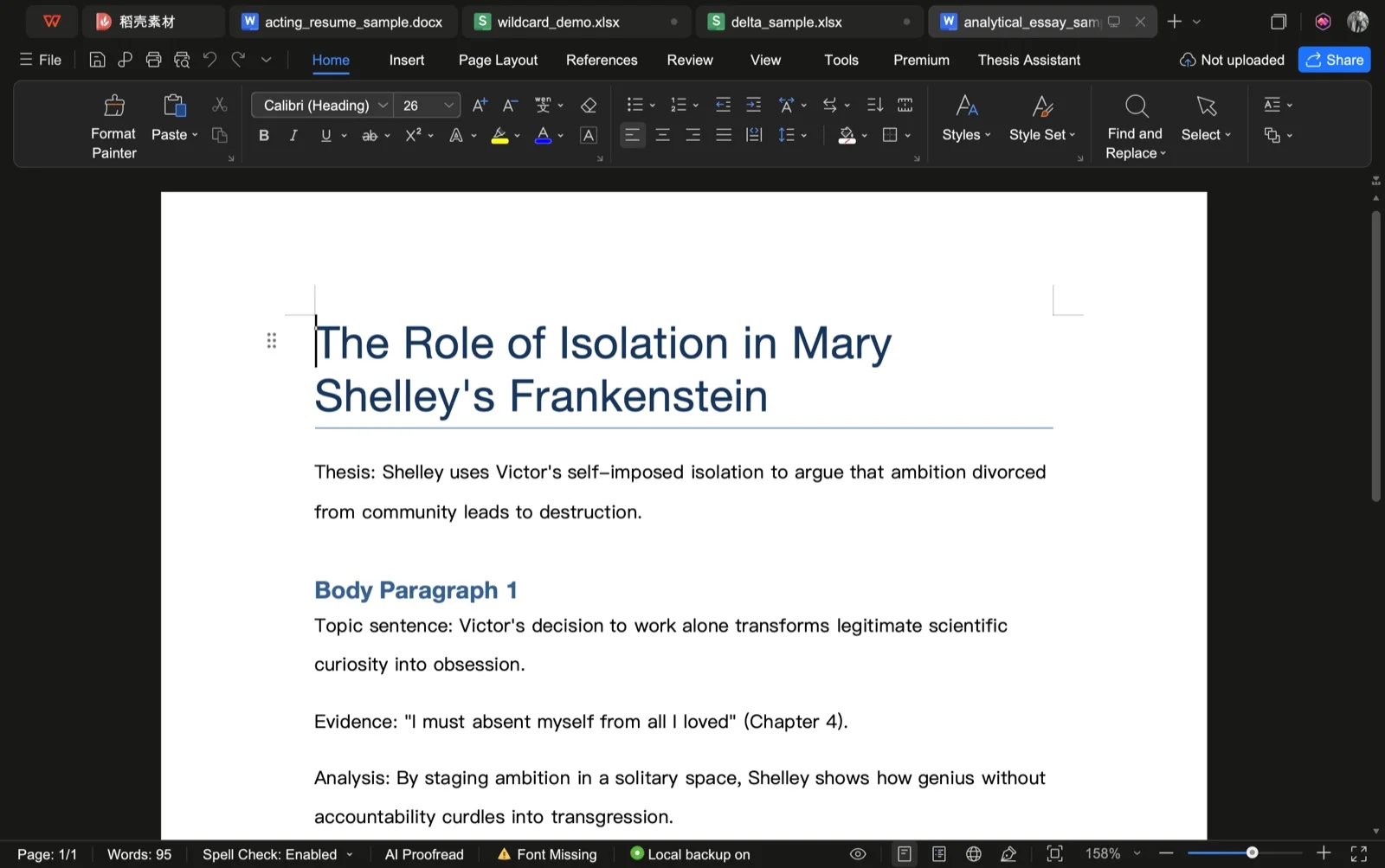
Drafting and formatting analytical essay in WPS Writer
Common Analytical Essay Mistakes (and How to Fix Them)
Most analytical essays lose points for the same four reasons, and each has a mechanical fix.
- Summarizing instead of analyzing. If a paragraph could survive in a book report, it is summary. Test every paragraph: after the evidence, do you explain why the author made that choice or what it proves? If not, add two sentences of interpretation - that is the analysis your grade hangs on.
- A thesis that states a fact. "Social media affects teenagers" is a topic, not a thesis. A thesis takes a position someone could dispute: "By shifting friendship from private dialogue to performed audience, Instagram redefined adolescent intimacy as visibility." The disputed claim gives every paragraph a job.
- Evidence dumping. Three quotes stacked in a row is a scrapbook, not an argument. Use the quote sandwich: claim, evidence, then at least two sentences of analysis tying the evidence back to the thesis. One quote analyzed deeply beats five quotes dropped.
- Ignoring the counterargument. An analytical essay that never acknowledges the opposing reading looks afraid of it. Address the strongest alternative interpretation in one paragraph, then show why yours explains the evidence better - this move reliably lifts an essay a full grade band.
A fast self-test before submitting: read only your topic sentences in order. If they tell a complete, debatable argument by themselves, the essay is analytical. If they merely list what happens in each body paragraph, you have written a summary with citations.
Mistake one - a topic statement posing as a thesis: an analytical thesis makes a claim about how something works or what it means, not a statement that the thing exists. This essay discusses social media and mental health is a topic; Instagram's design choices shift adolescents' self-evaluation from achievement to appearance is an analysis that can be defended or attacked. Test every draft thesis with the so-what question: if a skeptical reader can answer so what with a shrug, the thesis is a label, not an argument.
Mistake two - summary crowding out analysis: the most common proportion failure is two paragraphs of plot for every one of interpretation. Instructors read the summary lines and mark them with a single comment: analysis. Use the one-to-two rule - for every sentence of source material you present, follow with at least two sentences of your own reasoning about why it matters to the thesis. If you cannot generate those two sentences, the evidence does not actually support the point, and cutting the paragraph improves the essay.
Mistake three - evidence dropped in without framing: quotations and data need three moves: a lead-in that situates the source, the evidence itself, and an interpretation that ties it to the claim. Dropping a quotation into a paragraph and moving on leaves the reader to do the analysis you are being graded on. A workable habit is to read each body paragraph aloud and check that every quotation is followed by a sentence beginning with a verb of interpretation - this shows, this suggests, this reveals - rather than another quotation.
Mistake four - an outline skipped or ignored: analytical essays drift when the outline is a list of topics instead of a chain of claims. Write the outline as one sentence per paragraph, where each sentence states the paragraph's claim and how it advances the thesis; if two sentences make the same claim, one paragraph is redundant, and if a sentence does not connect to the thesis, the essay has a hole. Ten minutes with this kind of outline replaces an hour of restructuring after a draft.
Mistake five - no editing pass: first drafts of analysis are consistently 20 percent summary and 30 percent hedging. Reserve one pass purely for deletion: remove throat-clearing openings such as since the dawn of time, remove qualifiers that soften every claim, and check that the conclusion adds a synthesis rather than restating the introduction. Reading the final version backward, paragraph by paragraph, exposes the drift that forward reading hides.
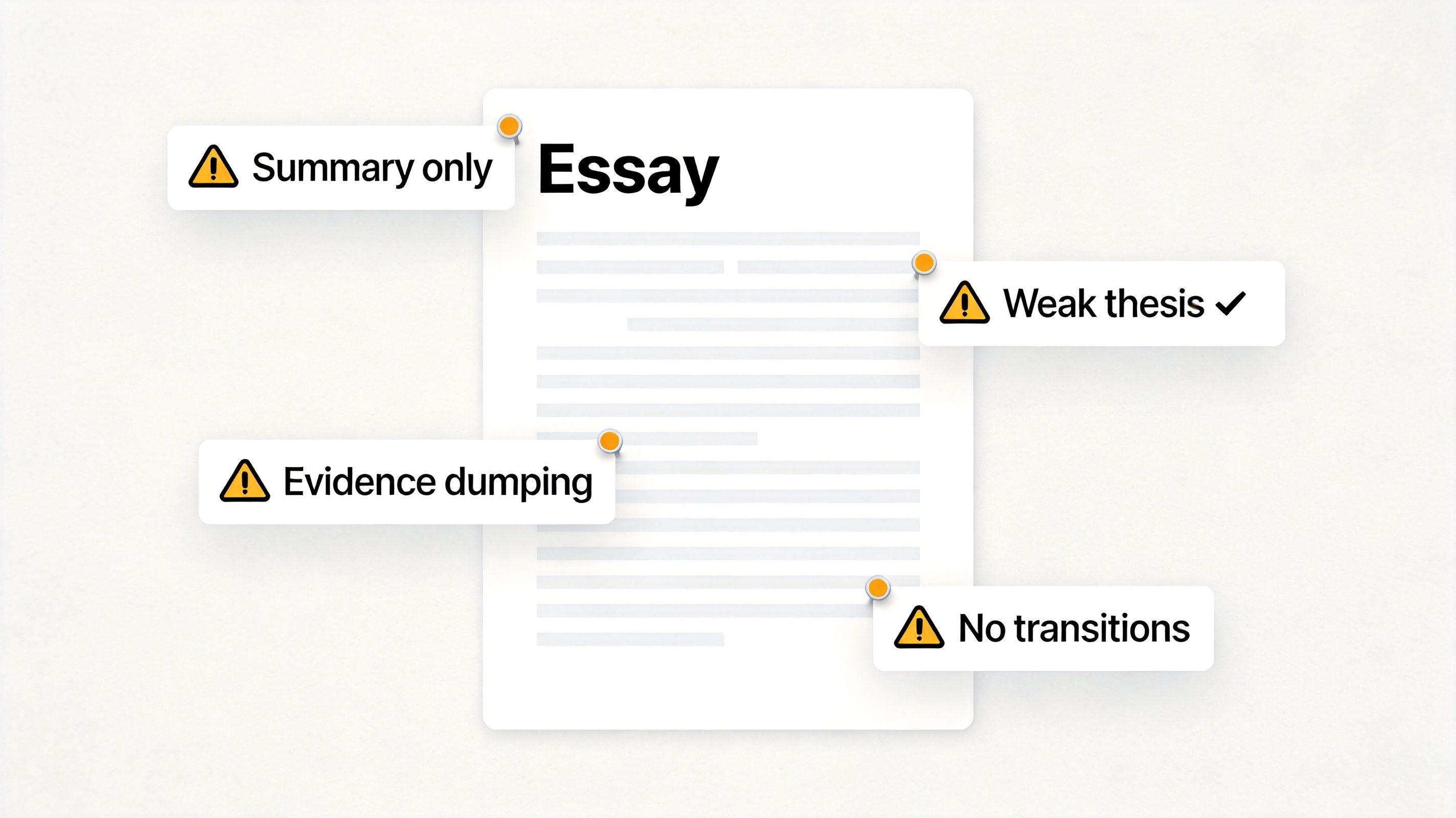
Common analytical essay mistakes and fixes
FAQs
What is an analytical essay?
An analytical essay examines a text, film, or idea by breaking it into parts and explaining how those parts create its meaning, using evidence rather than personal opinion.
How long should an analytical essay be?
It depends on the assignment, but a standard one runs about five paragraphs — an introduction, three body paragraphs, and a conclusion — with each body point fully argued.
What is the difference between analytical and argumentative essays?
An analytical essay explains how a work means what it means, while an argumentative essay argues a position and tries to persuade the reader to agree with it.
How do I start an analytical essay?
Open with the work and its context, then narrow to a specific, arguable thesis that states your reading of it, so the rest of the essay proves that point.
What is a good structure for an analytical essay?
Use an introduction with a thesis, body paragraphs that each make one claim backed by evidence, and a conclusion that explains the wider meaning of your analysis.