

'%3e%3cpath%20d='M8%200C12.4183%200%2016%203.58172%2016%208C16%2012.4183%2012.4183%2016%208%2016C3.58172%2016%200%2012.4183%200%208C0%203.58172%203.58172%200%208%200ZM11.6162%204.38379C11.2257%203.99337%2010.5927%203.99338%2010.2021%204.38379L8%206.58594L5.79785%204.38379C5.40732%203.99334%204.77429%203.99329%204.38379%204.38379C3.99331%204.77429%203.99335%205.40733%204.38379%205.79785L6.58594%208L4.38379%2010.2021C3.99348%2010.5927%203.99341%2011.2257%204.38379%2011.6162C4.77426%2012.0066%205.40734%2012.0065%205.79785%2011.6162L8%209.41406L10.2021%2011.6162C10.5927%2012.0066%2011.2257%2012.0067%2011.6162%2011.6162C12.0067%2011.2257%2012.0066%2010.5927%2011.6162%2010.2021L9.41406%208L11.6162%205.79785C12.0066%205.40735%2012.0066%204.77429%2011.6162%204.38379Z'%20fill='%23080E17'%20fill-opacity='0.46'/%3e%3c/g%3e%3cdefs%3e%3cclipPath%20id='clip0_3761_713'%3e%3crect%20width='16'%20height='16'%20fill='white'/%3e%3c/clipPath%3e%3c/defs%3e%3c/svg%3e)




'%3e%3cpath%20fill-rule='evenodd'%20clip-rule='evenodd'%20d='M21.4999%2010.9993C21.4999%205.20009%2016.7986%200.498901%2010.9993%200.498901C5.19994%200.498901%200.498657%205.20009%200.498657%2010.9993C0.498657%2016.2404%204.33858%2020.5844%209.35855%2021.3722V14.0346H6.69238V10.9993H9.35855V8.68594C9.35855%206.05427%2010.9262%204.60062%2013.3248%204.60062C14.4736%204.60062%2015.6753%204.80571%2015.6753%204.80571V7.38979H14.3512C13.0468%207.38979%2012.64%208.19921%2012.64%209.0296V10.9993H15.5523L15.0867%2014.0346H12.64V21.3722C17.66%2020.5844%2021.4999%2016.2404%2021.4999%2010.9993Z'%20fill='%231568EA'/%3e%3c/g%3e%3c/svg%3e)


'%3e%3cpath%20d='M2.42045%2022.1876H6.31818V12.7217L0.75%208.54553V20.5171C0.75%2021.4414%201.49892%2022.1876%202.42045%2022.1876Z'%20fill='%234285F4'/%3e%3cpath%20d='M19.682%2022.1876H23.5797C24.5041%2022.1876%2025.2502%2021.4387%2025.2502%2020.5171V8.54553L19.682%2012.7217'%20fill='%2334A853'/%3e%3cpath%20d='M19.682%205.48293V12.7216L25.2502%208.54543V6.31816C25.2502%204.25236%2022.8921%203.07469%2021.2411%204.31361'%20fill='%23FBBC04'/%3e%3cpath%20d='M6.31824%2012.7217V5.48303L13.0001%2010.4944L19.6819%205.48303V12.7217L13.0001%2017.733'%20fill='%23EA4335'/%3e%3cpath%20d='M0.75%206.31816V8.54543L6.31818%2012.7216V5.48293L4.75909%204.31361C3.10534%203.07469%200.75%204.25236%200.75%206.31816Z'%20fill='%23C5221F'/%3e%3c/g%3e%3cdefs%3e%3cclipPath%20id='clip0_2954_7305'%3e%3crect%20width='24.5'%20height='18.375'%20fill='white'%20transform='translate(0.75%203.8125)'/%3e%3c/clipPath%3e%3c/defs%3e%3c/svg%3e)


The first hour of your day sets the tone for the next twelve. When that hour runs on autopilot — snooze, phone, coffee, scramble — you arrive at your desk already behind. When it runs on a short, repeatable sequence, you arrive with energy and a clear first task.
A useful routine is not about becoming a 5 a.m. person. It is about removing small decisions and adding small actions that compound. The morning routine ideas below are grouped by what they actually do: wake up your body first, then focus your mind before work begins.
You will also find how to choose the ideas that fit your real schedule, how to plan them in WPS Office so the plan survives past week one, and the habits that quietly break a routine.
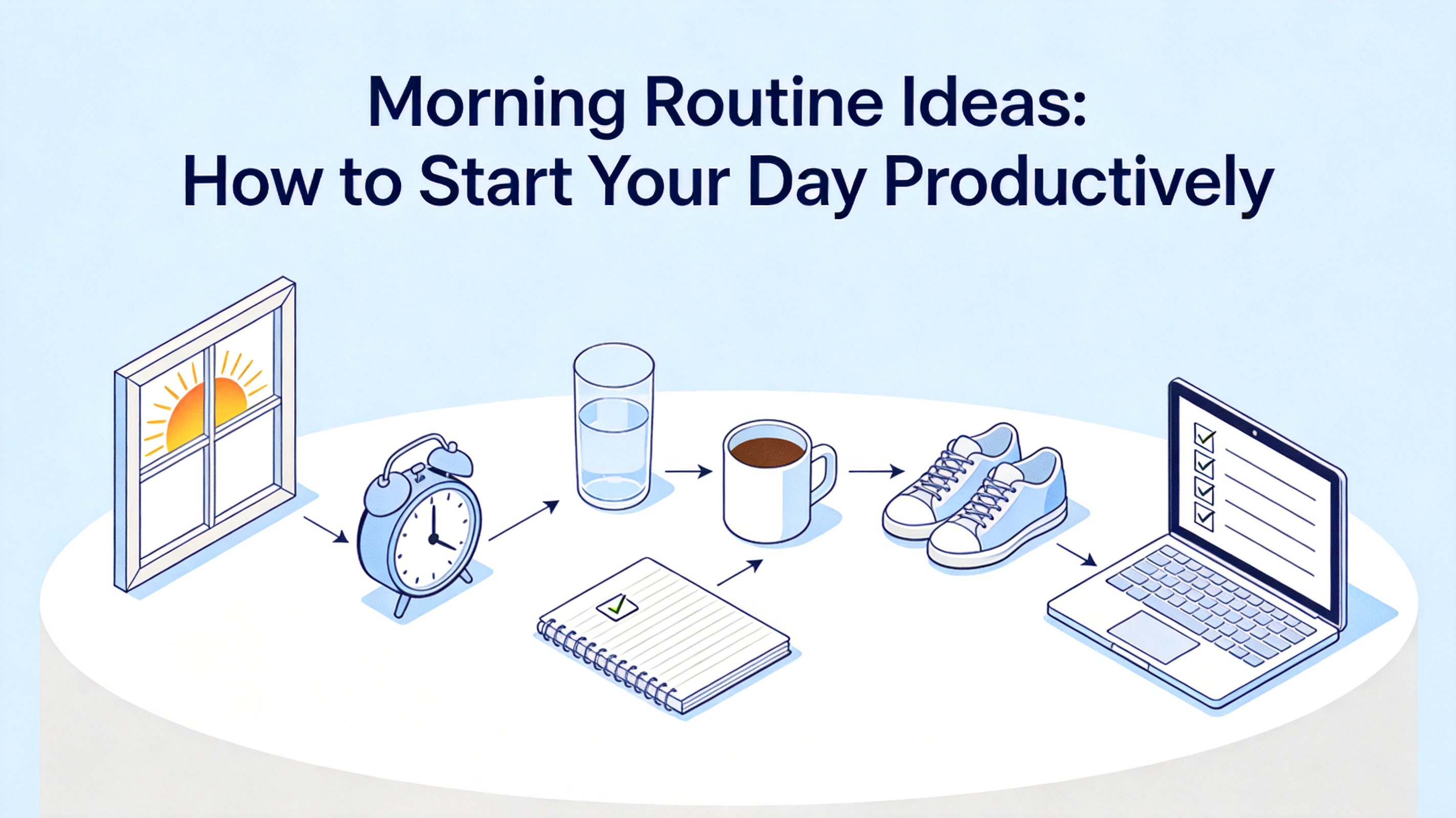
Morning Routine Ideas: How to Start Your Day Productively
Why Morning Routine Ideas Matter More Than Motivation
Motivation is unreliable at 6:30 in the morning. A routine works because it is fixed: you follow an order instead of making choices. That matters more than most people expect, because every small morning decision — what to wear, what to eat, what to do first — draws on the same limited attention you need for real work.
A steady wake time steadies the body clock. Going to bed and getting up at roughly the same time each day keeps your internal clock predictable, which is why a routine built on a consistent wake time feels easier than one that depends on willpower.
Light and movement wake the brain sooner than caffeine. Daylight early in the morning helps signal that the night is over, and a few minutes of movement raises alertness without a second cup of coffee.
A planned morning protects your best hours. Most people get one or two clear-headed blocks a day. If your first block goes to email, the work that needs real thinking gets pushed to the afternoon, when you have less to give it.
None of this requires an elaborate system. It requires an order you can still follow on a bad day.
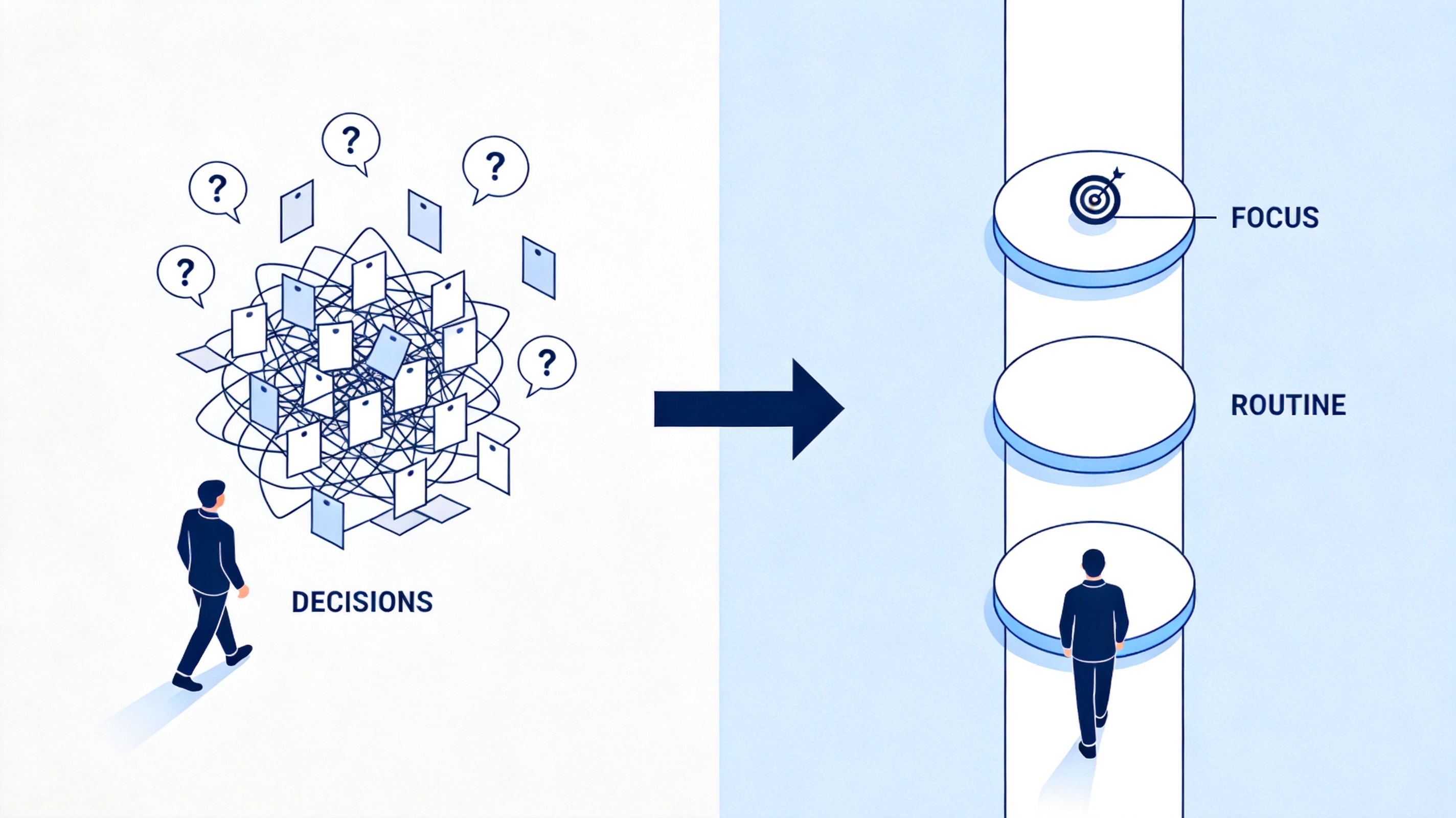
Too many decisions versus one routine


How to Choose the Right Morning Routine Ideas for Your Schedule
The fastest way to fail is to copy a routine designed for someone with a different schedule. Use this short process instead.
Audit your first hour for a week. Write down what you actually do between waking up and starting work, including the phone time. You cannot design a routine around a morning you have not looked at.
Anchor the routine to your real wake time. A routine that starts 20 minutes after you normally get up is realistic. One that starts 90 minutes earlier is a second, unrelated project.
Match ideas to the energy you have. If you wake up foggy, lead with physical ideas such as daylight, water, and movement. If you wake up alert, move the planning and deep-work ideas to the front.
Start with two habits, not seven. Two habits you repeat for two weeks teach you more than seven you attempt for two days. Add a third only when the first two happen without thinking.
Attach each habit to a cue you already have. Drink water when you start the kettle, write your three tasks when you sit at the desk. Habits that ride on an existing action need far less discipline.
Review once a week. Five minutes on a Sunday is enough: keep what worked, drop what you skipped twice, and change only one thing at a time.
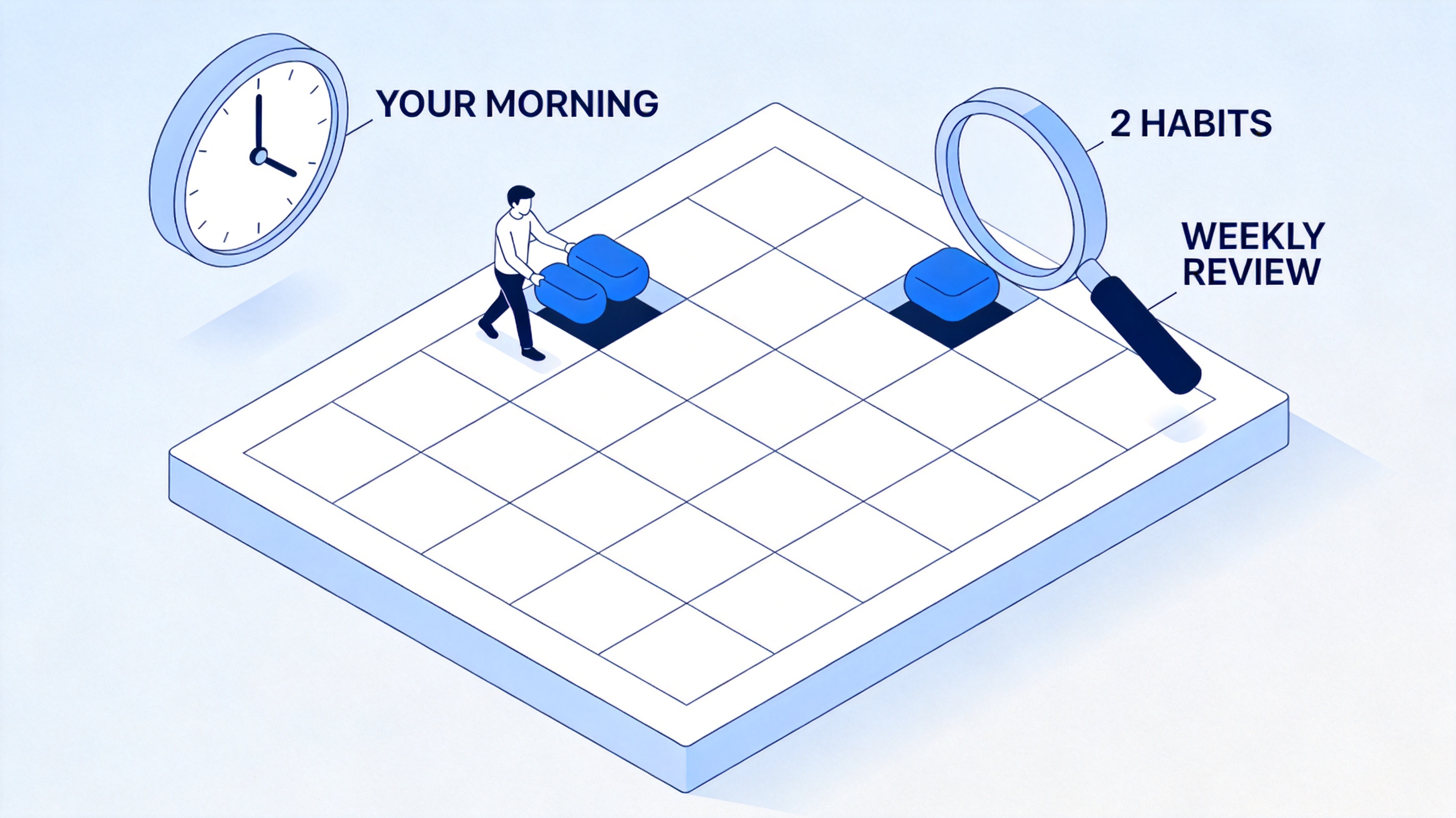
Morning routine ideas chosen by schedule
Morning Routine Ideas to Wake Up Your Body and Energy
Start with the physical basics. These are the cheapest ideas to adopt because they need no planning, no equipment, and no extra time you do not have.
Wake up at a consistent time. Your wake time matters more than your bedtime. Keeping it within the same half hour every day, weekends included, makes mornings noticeably less painful within a week or two.
Get out of bed on the first alarm. Snoozing restarts the sleep cycle you were about to leave, which is why the second wake-up usually feels worse than the first. Put the alarm across the room if that is what it takes.
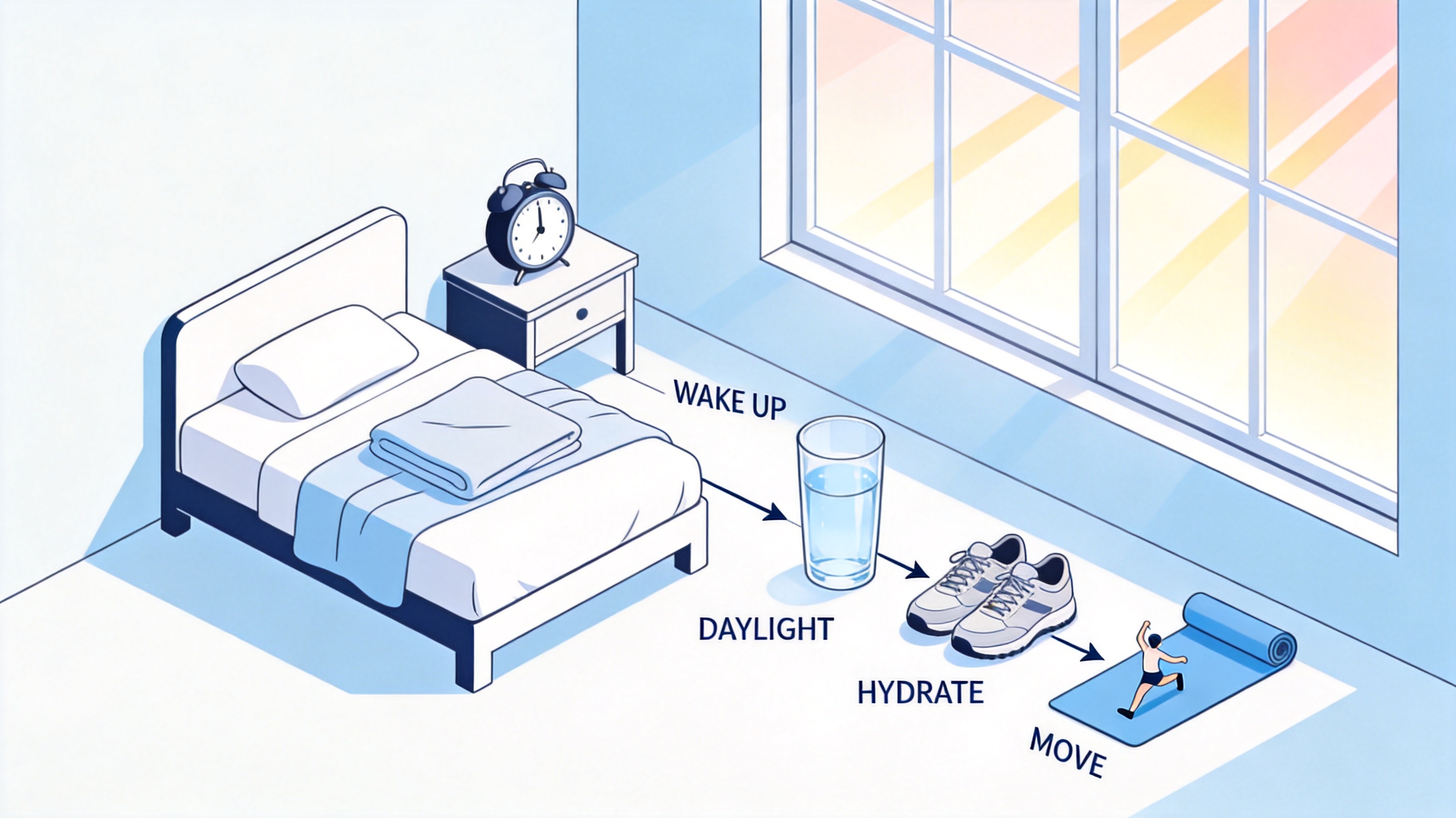
Wake up, hydrate, move, morning routine
Get daylight early. Open the curtains or step outside for a minute or two. Natural light is the strongest signal your body uses to switch from sleep to awake.
Drink water before coffee. You wake up dehydrated after seven or eight hours without fluid. A glass of water first, then coffee, is one of the simplest changes on this list.
Move for ten minutes. A short walk, a few stretches, or a ten-minute bodyweight circuit is enough. The goal is to wake the body up, not to train.
Eat something that lasts. If breakfast is part of your morning, choose something with protein or fiber rather than only sugar and caffeine, so you are not hungry again by ten.
Morning Routine Ideas to Focus Your Mind Before Work
Once your body is awake, the second half of a routine decides what the day is actually spent on. These ideas take ten to twenty minutes in total.
Write down your top three tasks. Not a full to-do list — three items, in order. If everything is a priority, nothing is, and a three-item plan is short enough that you will actually finish it.
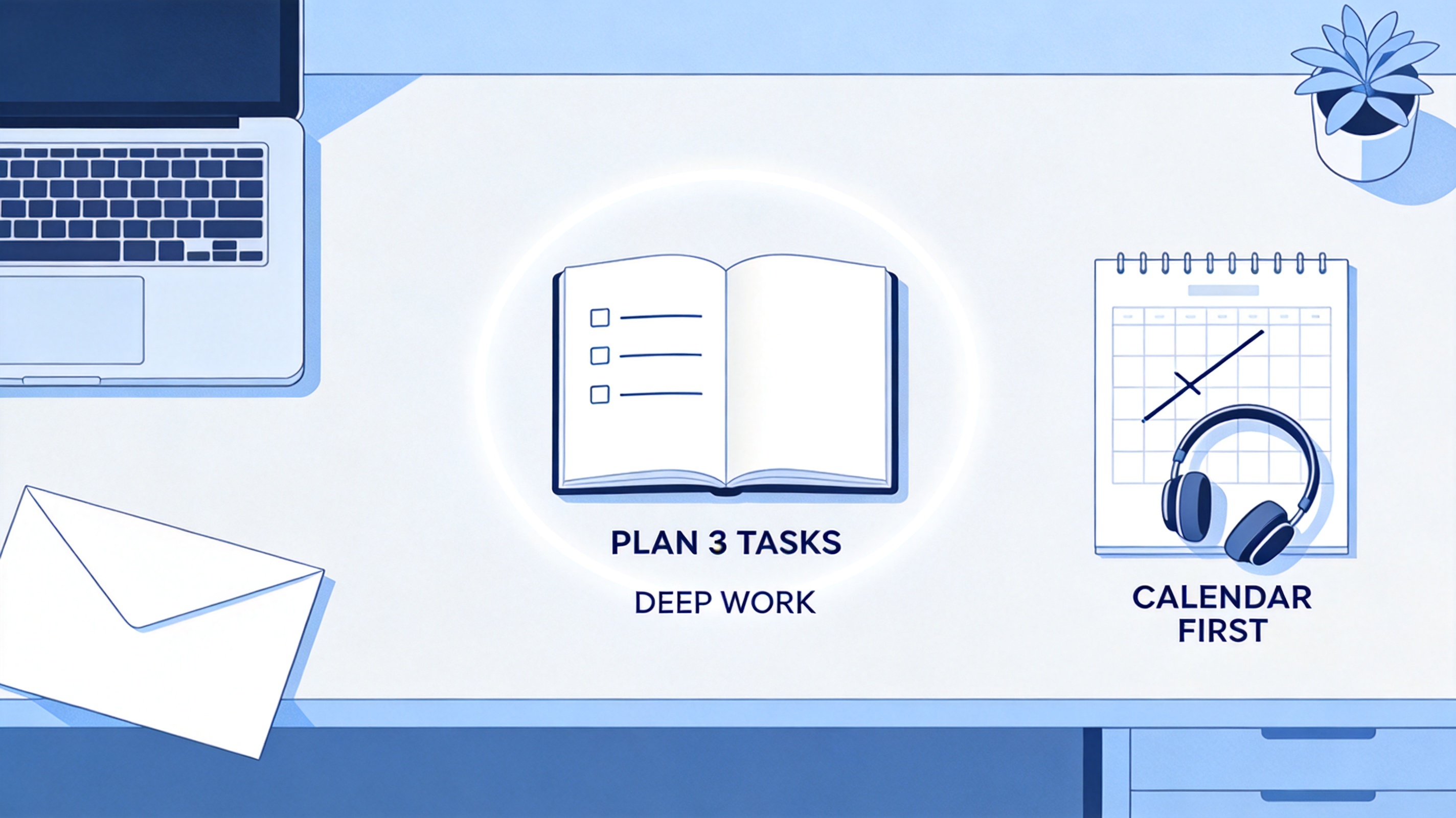
Plan three tasks before deep work
Review your calendar before your inbox. The calendar tells you how much time you really have; the inbox tells you what other people want from you. Look at the day’s meetings first, then decide where focused work can fit.
Do the hardest task first. Use the first clear-headed block for the work that needs thinking, and let messages, admin, and small requests wait for later in the morning.
Read or listen to something useful for ten minutes. A few pages of a book, a saved article, or a short podcast episode gives you something to think with for the rest of the day.
Tidy your desk and close the extra tabs. A clear surface and a browser with five tabs instead of thirty removes a surprising number of small distractions before they start.
Protect ten quiet minutes. Journaling, planning, or simply sitting without a screen keeps the routine from becoming a second job. Guard that time the way you would guard a meeting.
How to Plan Your Morning Routine Ideas in WPS Office
Ideas fade by Wednesday unless they live somewhere you will see them. WPS Office is a practical place to keep them: the plan, the checklist, and the habit tracker stay in one file that opens on your desktop before work and on your phone afterwards. WPS Office is free and available for Windows, macOS, Linux, Android, iOS, and iPad.
Start from a template instead of a blank page. Open WPS Office, click + (New) in the top tab bar, choose Document or Spreadsheet, search for a term such as daily planner or habit tracker, then click Use Now to apply the template you picked.
Turn your morning into a simple table. Add a four-column table — Time, Task, Priority, Done — and fill in five rows for one morning only. Keep the list small enough that you will still follow it on a busy day.
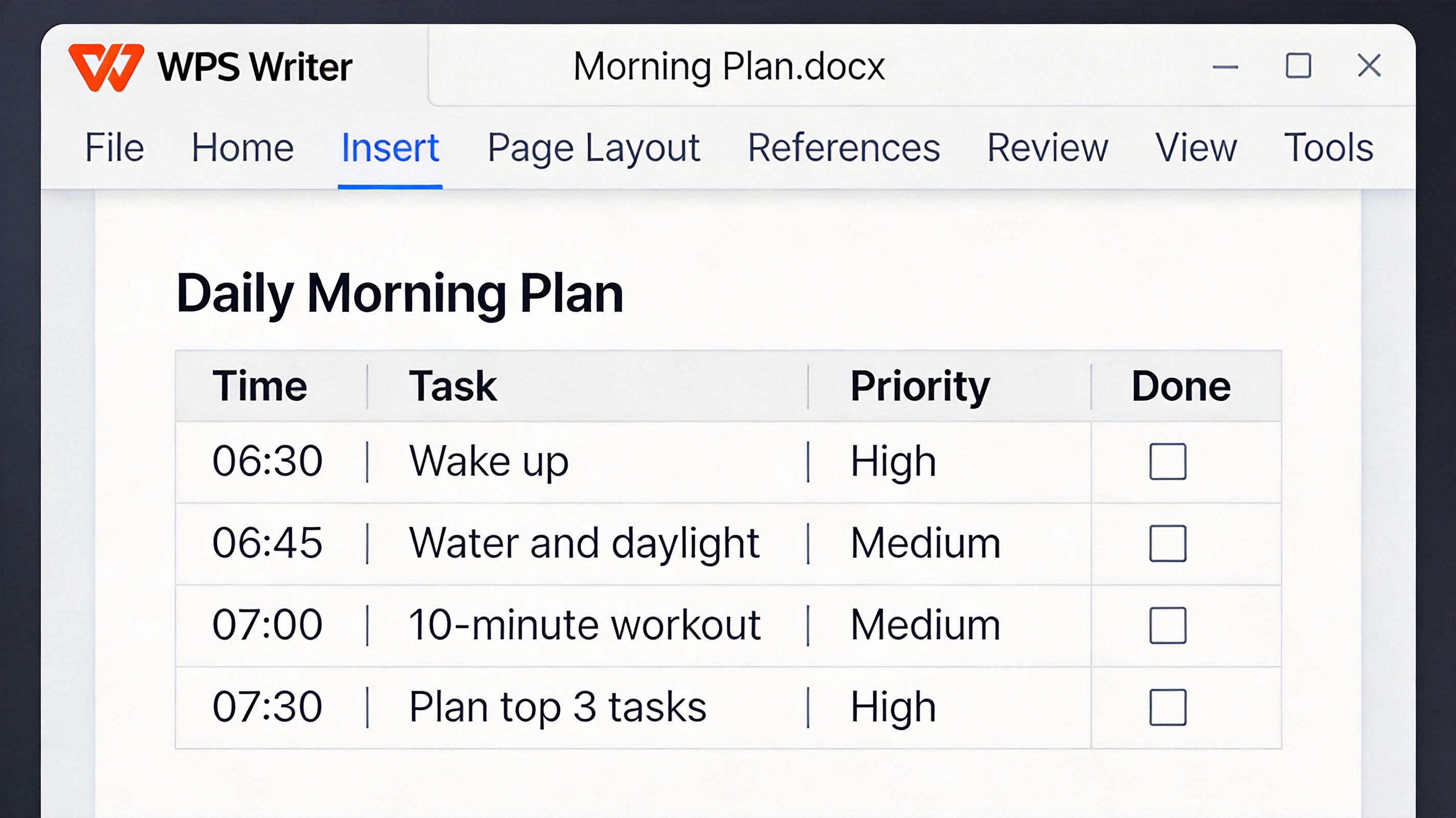
Morning plan table in WPS Writer
Track the habits you want to keep. In WPS Spreadsheet, put one habit per row and one column per day, then mark each day with a check. A simple formula such as =COUNTIF(B2:H2,"✓") turns a week of checkmarks into a streak you can see at a glance.
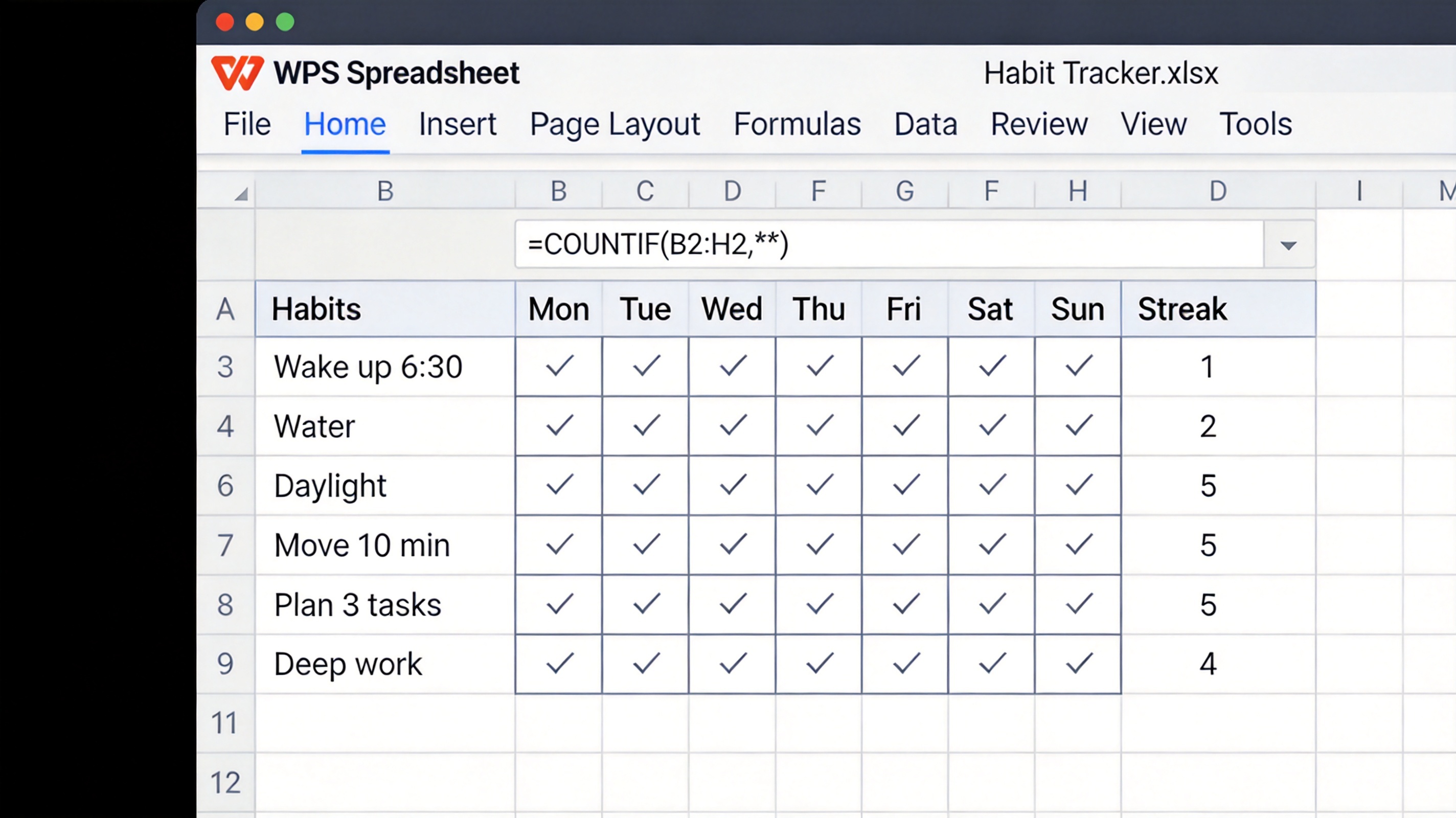
Habit tracker grid in WPS Spreadsheet
Export the plan to PDF. Open the Tools tab and click Export to PDF. The same entrance works in WPS Writer, WPS Spreadsheet, and WPS Presentation, which is handy for printing the plan or reading it on a tablet without editing it by accident.
Keep it with you and tick it off. Save the file to WPS Cloud and open it in the WPS Office mobile app. Items you tick off sync back to the desktop version, so the tracker stays honest instead of becoming another optimistic document.
If you want to build the checklist itself rather than use a template, this guide to creating a checklist in Word covers checkboxes and formatting, and the free calendar and planner templates give you a ready-made weekly layout to fill in.
The Best Free Alternative for Your Morning Routine: WPS Office
Most planning tools force a choice between a heavy office suite and a lightweight app that cannot open the files your work actually uses. WPS Office sits in the middle: a free suite with Writer, Spreadsheet, Presentation, and PDF tools, plus AI Copilot built into the app.
For a morning routine, three things matter:
Real templates. Daily planners, calendars, and habit trackers are already built, so nobody starts the day staring at a blank page.
Desktop and mobile, same file. Plan the morning on your laptop, tick items off on your phone, and let WPS Cloud keep both copies in step.
File compatibility. Open, edit, and export the .docx, .xlsx, .pptx, and PDF files you already have, and export your own plan to PDF when you want it on paper.
The desktop apps also work offline, which matters if your best planning window happens before the Wi-Fi is awake. You can use one tool for the plan, the checklist, and the record of whether you followed it.
WPS Office homepage with free download
Morning Routine Ideas That Quietly Backfire
Most routines do not fail because of laziness. They fail because of a few predictable errors.
Stacking too many habits at once. A seven-step routine built on Monday is usually a two-step routine by Friday. Add habits one at a time.
Hitting snooze three times. Each snooze restarts the grogginess you were already escaping, and it eats the quiet minutes the rest of the routine depends on.
Opening your phone before your own plan. If the first thing you read is other people’s requests, you spend the morning reacting. Ten minutes of your own agenda first changes the whole day.
Building a routine that eats the morning. A 90-minute routine sounds impressive and survives for a week. Fifteen minutes you repeat every day beats it.
Copying someone else’s routine. A 5 a.m. cold-plunge schedule is not a productivity rule. Take the principles — light, water, movement, a short plan — and set your own times.
Tracking nothing. Without a simple record you cannot tell what is working. One spreadsheet row per habit is enough to make the decision for you.
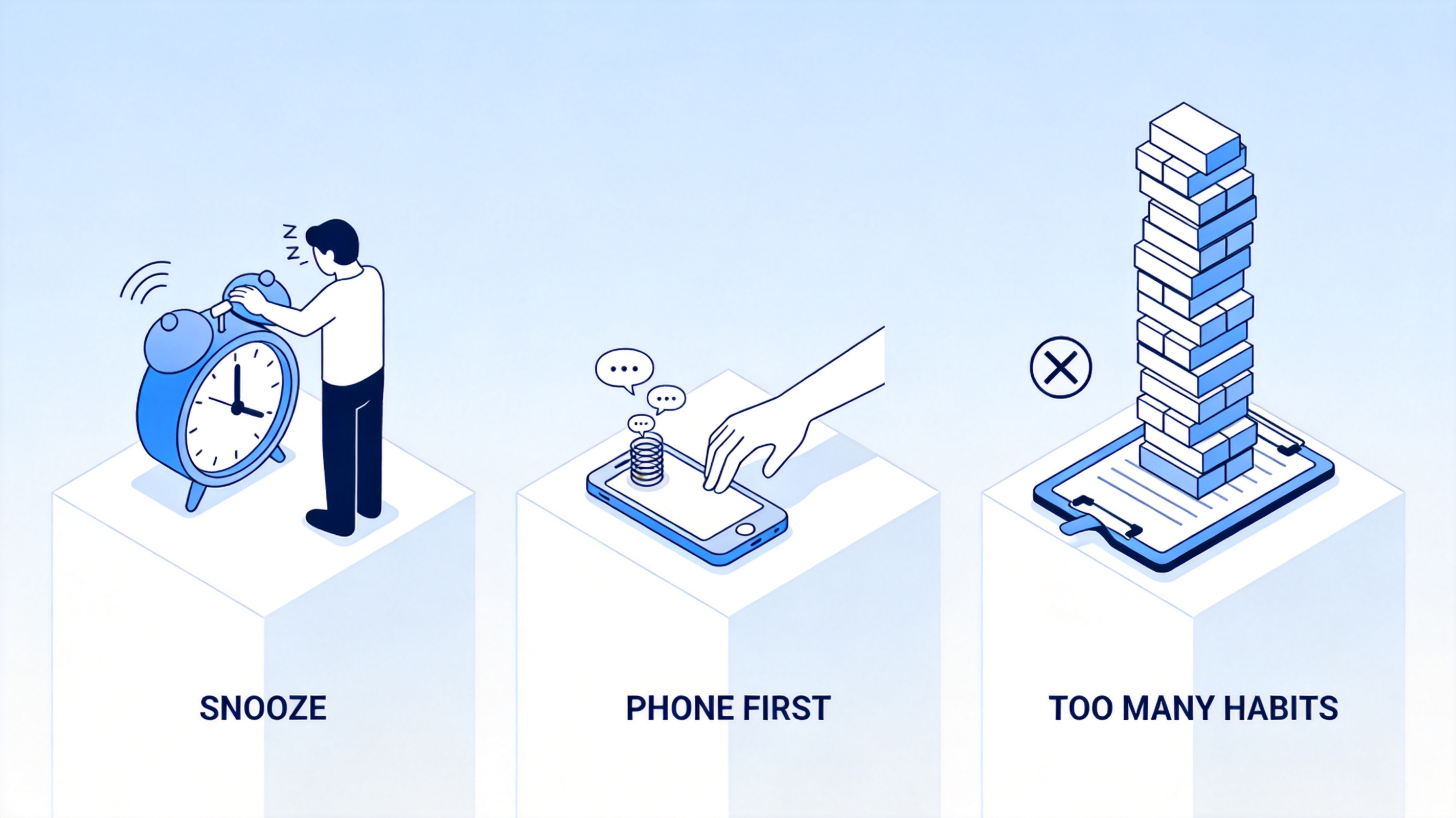
Morning routine mistakes: snooze, phone, overload
FAQs
What is the best time to start a morning routine?
Right after your normal wake time. What matters is a fixed sequence after waking, not an early clock time. An 8:15 routine you keep is worth more than a 5:30 routine you abandon in a week.
How many morning routine ideas should you try at once?
Two. Add a third only when the first two happen without thinking. Three habits you actually keep will outperform ten you drop by Thursday.
How long should a morning routine take?
Fifteen to forty-five minutes covers everything on this list. Build the 15-minute version first, then expand it using time you genuinely have rather than time you hope to have.
Can you plan a morning routine in WPS Office for free?
Yes. WPS Office is free and includes templates for daily planners, calendars, and habit trackers, plus Writer, Spreadsheet, Presentation, and PDF tools. You can export the plan to PDF, or sync it to the mobile app and tick items off during the day.
What if you are not a morning person?
Move the routine to the start of your day, whenever that is. Daylight, water, and a three-item plan work at 6 a.m. and at 10 a.m. If your mornings are genuinely your worst hours, keep the morning version short and protect a focused block later.

'%3e%3cpath%20d='M19.9911%204.11386V6.471H18.5894C18.0775%206.471%2017.7322%206.57814%2017.5536%206.79243C17.3751%207.00671%2017.2858%207.32814%2017.2858%207.75671V9.44421H19.9019L19.5536%2012.0871H17.2858V18.8639H14.5536V12.0871H12.2769V9.44421H14.5536V7.49779C14.5536%206.39064%2014.8632%205.53201%2015.4822%204.92189C16.1013%204.31177%2016.9257%204.00671%2017.9554%204.00671C18.8304%204.00671%2019.509%204.04243%2019.9911%204.11386Z'%20fill='%23333333'/%3e%3c/g%3e%3cdefs%3e%3cclipPath%20id='clip0_2938_8199'%3e%3crect%20width='16'%20height='16'%20fill='white'%20transform='translate(8%204.00671)'/%3e%3c/clipPath%3e%3c/defs%3e%3c/svg%3e)
'%3e%3cpath%20d='M17.5237%2010.7813L23.4811%204H22.0699L16.8949%209.88693L12.7648%204H8L14.2469%2012.9029L8%2020.0133H9.4112L14.8725%2013.7952L19.2352%2020.0133H24M9.92053%205.04213H12.0885L22.0688%2019.0224H19.9003'%20fill='%23333333'/%3e%3c/g%3e%3cdefs%3e%3cclipPath%20id='clip0_2938_8200'%3e%3crect%20width='16'%20height='16.0134'%20fill='white'%20transform='translate(8%204)'/%3e%3c/clipPath%3e%3c/defs%3e%3c/svg%3e)


