

'%3e%3cpath%20d='M8%200C12.4183%200%2016%203.58172%2016%208C16%2012.4183%2012.4183%2016%208%2016C3.58172%2016%200%2012.4183%200%208C0%203.58172%203.58172%200%208%200ZM11.6162%204.38379C11.2257%203.99337%2010.5927%203.99338%2010.2021%204.38379L8%206.58594L5.79785%204.38379C5.40732%203.99334%204.77429%203.99329%204.38379%204.38379C3.99331%204.77429%203.99335%205.40733%204.38379%205.79785L6.58594%208L4.38379%2010.2021C3.99348%2010.5927%203.99341%2011.2257%204.38379%2011.6162C4.77426%2012.0066%205.40734%2012.0065%205.79785%2011.6162L8%209.41406L10.2021%2011.6162C10.5927%2012.0066%2011.2257%2012.0067%2011.6162%2011.6162C12.0067%2011.2257%2012.0066%2010.5927%2011.6162%2010.2021L9.41406%208L11.6162%205.79785C12.0066%205.40735%2012.0066%204.77429%2011.6162%204.38379Z'%20fill='%23080E17'%20fill-opacity='0.46'/%3e%3c/g%3e%3cdefs%3e%3cclipPath%20id='clip0_3761_713'%3e%3crect%20width='16'%20height='16'%20fill='white'/%3e%3c/clipPath%3e%3c/defs%3e%3c/svg%3e)



'%3e%3cpath%20fill-rule='evenodd'%20clip-rule='evenodd'%20d='M21.4999%2010.9993C21.4999%205.20009%2016.7986%200.498901%2010.9993%200.498901C5.19994%200.498901%200.498657%205.20009%200.498657%2010.9993C0.498657%2016.2404%204.33858%2020.5844%209.35855%2021.3722V14.0346H6.69238V10.9993H9.35855V8.68594C9.35855%206.05427%2010.9262%204.60062%2013.3248%204.60062C14.4736%204.60062%2015.6753%204.80571%2015.6753%204.80571V7.38979H14.3512C13.0468%207.38979%2012.64%208.19921%2012.64%209.0296V10.9993H15.5523L15.0867%2014.0346H12.64V21.3722C17.66%2020.5844%2021.4999%2016.2404%2021.4999%2010.9993Z'%20fill='%231568EA'/%3e%3c/g%3e%3c/svg%3e)


'%3e%3cpath%20d='M2.42045%2022.1876H6.31818V12.7217L0.75%208.54553V20.5171C0.75%2021.4414%201.49892%2022.1876%202.42045%2022.1876Z'%20fill='%234285F4'/%3e%3cpath%20d='M19.682%2022.1876H23.5797C24.5041%2022.1876%2025.2502%2021.4387%2025.2502%2020.5171V8.54553L19.682%2012.7217'%20fill='%2334A853'/%3e%3cpath%20d='M19.682%205.48293V12.7216L25.2502%208.54543V6.31816C25.2502%204.25236%2022.8921%203.07469%2021.2411%204.31361'%20fill='%23FBBC04'/%3e%3cpath%20d='M6.31824%2012.7217V5.48303L13.0001%2010.4944L19.6819%205.48303V12.7217L13.0001%2017.733'%20fill='%23EA4335'/%3e%3cpath%20d='M0.75%206.31816V8.54543L6.31818%2012.7216V5.48293L4.75909%204.31361C3.10534%203.07469%200.75%204.25236%200.75%206.31816Z'%20fill='%23C5221F'/%3e%3c/g%3e%3cdefs%3e%3cclipPath%20id='clip0_2954_7305'%3e%3crect%20width='24.5'%20height='18.375'%20fill='white'%20transform='translate(0.75%203.8125)'/%3e%3c/clipPath%3e%3c/defs%3e%3c/svg%3e)


You finally finished your resume. A recruiter replies: “Please send a PDF and fix the job title on line three.” Simple request—until you open the file and realize a PDF resume editor is harder to find than the job itself. Text jumps, bullets refuse to align, and a “quick edit” turns into a full redesign an hour before the deadline.
That is the everyday job-search reality. Most applications prefer PDF because it looks consistent across devices. The problem is that PDF was never designed for casual rewriting. If you only have Word, screenshots, or a free online converter, editing a resume PDF becomes a stressful loop of broken layout and last-minute panic.
The Three Dead Ends of PDF Resume Editing
Before comparing tools, it helps to name the traps that catch most applicants:
Layout lock: PDF text is often not “live.” Change one word and spacing, fonts, or section borders collapse.
Conversion damage: Exporting PDF → Word → PDF again can scramble dates, skills columns, and ATS-readable text.
Tool chaos: One app to edit, another to convert, a third to check formatting—and none of them care whether your resume will pass an Applicant Tracking System.
This guide reviews seven popular PDF resume editors people actually search for online, then explains where they fall short—and how a better all-in-one workflow can save both time and application quality.


7 Popular PDF Resume Editors Compared
Here is a practical breakdown of mainstream options. Each entry covers what it does well for resume edits, where it struggles, and who it fits best.
1. Adobe Acrobat Pro
Best for: Power users who already pay for Adobe and need precise PDF editing.
Adobe Acrobat Pro is the industry benchmark for a professional PDF resume editor. You can edit text in place, adjust images, reorder pages, and export clean files. For dense, design-heavy resumes, the control is excellent.
Pros: Accurate text editing, strong export quality, reliable fonts
Cons: Expensive subscription; overkill for a one-line resume fix; steep for students and freshers
Resume note: Great if budget is not an issue; weak as a free resume workflow
2. PDFgear — Free Favorite with Strong Word of Mouth
Best for: Users hunting a free desktop PDF editor with OCR and basic resume tweaks.

PDFgear has built a reputation as a free alternative to Acrobat. It supports editing, conversion, OCR, and compression—useful when your resume PDF is scanned or oversized for portal uploads.
Pros: Free core features, desktop workflow, conversion tools
Cons: UI can feel busy; advanced polish still trails Acrobat; not resume-specialized
Resume note: Fine for small text fixes, not ideal for rebuilding a full CV from scratch
3. Smallpdf
Best for: Quick online edits when you cannot install software.

Smallpdf is a popular browser toolkit. Upload a resume PDF, edit or convert, download, and move on. It is convenient for travelers or shared computers.
Pros: Fast, clean interface, many PDF utilities in one site
Cons: Free tier limits; privacy concerns if you upload personal career data; paywall appears quickly
Resume note: Risky for sensitive contact details and salary history in cloud uploads
4. iLovePDF
Best for: Lightweight online PDF tasks like compress, merge, or convert.

iLovePDF is widely used for PDF utilities. Editing exists, but many users primarily come for conversion and compression before submitting applications.
Pros: Familiar brand, solid conversion suite, mobile-friendly
Cons: Free limits and watermarks on some flows; editing depth is limited for complex resumes
Resume note: Better as a “prepare file” tool than a true resume content editor
5. PDF24 Creator
Best for: Windows users who want a free local toolbox.

PDF24 Creator is a free Windows-focused suite with editing, conversion, and printing tools. Local processing appeals to privacy-conscious applicants.
Pros: Free, offline-friendly, broad PDF utilities
Cons: Windows-centric; resume editing UX is utilitarian, not modern; Mac users are left out
Resume note: Useful for file prep, less inspiring for polished visual resumes
6. SimplePDF
Best for: Filling forms and making light annotations in the browser.

SimplePDF focuses on ease: open a PDF, type into fields, add text boxes, download. It can work for tiny resume corrections.
Pros: Extremely simple, no heavy install, quick for form-like PDFs
Cons: Not built for complex multi-section resumes; limited design control
Resume note: Good for a typo fix, weak for rewriting an entire experience section
7. Reactive Resume — Open-Source Path
Best for: Tech-savvy users who want free, privacy-first resume building and PDF export.

Reactive Resume is an open-source resume builder rather than a classic PDF patch editor. You rebuild content in a structured editor, then export PDF—attractive if you dislike uploading files to commercial SaaS tools.
Pros: Free/open approach, privacy-minded, modern templates
Cons: Learning curve; not a direct “open existing PDF and tweak one line” editor
Resume note: Excellent for rebuilding, not for emergency edits on a locked PDF from a recruiter
Where Most PDF Resume Editors Fall Short
Compare these seven options side by side and a pattern appears. The tools solve pieces of the problem—but rarely the whole job-search workflow.
1) Pricing traps. Acrobat is a full subscription. Online suites like Smallpdf and iLovePDF often look free until you hit daily limits, locked features, or premium export. A “one-minute edit” can become a checkout page.
2) Privacy risk. Uploading a resume means uploading your phone number, email, address history, and employer list. Browser tools may process files on remote servers. For many applicants, that is an unnecessary exposure.
3) Weak language and localization support. Multilingual job seekers—especially those writing mixed English/Chinese content or applying internationally—often hit font substitution, broken CJK spacing, or awkward UI translations.
4) ATS is ignored. A pretty PDF that fails parsing helps no one. Many editors optimize visual appearance, not selectable text, standard headings, or clean reading order for Applicant Tracking Systems.
5) Fragmented workflow. Edit here, convert there, template somewhere else, then open Word again for the next version. The result is version chaos: Resume_final_v7_REAL.pdf five minutes before midnight.
If those five pain points sound familiar, you do not need seven separate apps. You need one office suite that edits PDF, keeps Word/PDF dual formats, and still supports resume templates.
Why WPS Office Is a Smarter PDF Resume Editor
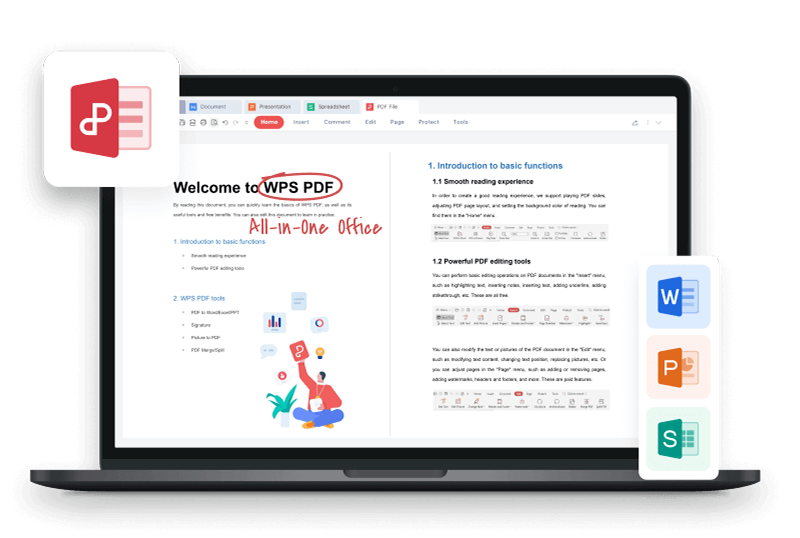
WPS Office addresses the gaps above with a practical, job-seeker-friendly approach: edit PDFs, convert when needed, manage Word masters, and pull resume templates—without stitching five websites together.
How WPS Maps to Each Shortcoming
Cost: Core PDF editing and office tools are available without forcing an Acrobat-level commitment for every small resume change.
Privacy: Desktop editing keeps sensitive career data on your device for local changes instead of routine cloud uploads.
Language support: Strong multilingual handling helps international applicants keep fonts and layout stable.
ATS readiness: You can keep a clean Word master, export selectable PDF text, and avoid image-only “flat” resumes.
End-to-end flow: One suite covers Writer, PDF, templates, and export—so versions stay organized.
How to Edit a PDF Resume in WPS (Quick Walkthrough)

Open the PDF in WPS Office PDF tools.
Edit text directly for small fixes (title, date, phone number), or convert to Word when you need deeper restructuring.
Adjust layout carefully: keep one-page length, consistent fonts (Arial/Calibri 10–12 pt), and 0.5–1 inch margins.
Export/save as PDF with selectable text—not a screenshot-style image PDF.
QA check: open the final file, confirm headings, dates, and links, then name it professionally (FirstName_LastName_Resume.pdf).
For larger rewrites, keep an editable Word version as your master and generate PDF for each application. That dual-format habit is what most “PDF-only” websites cannot match.
Extra Advantages for Job Seekers
Resume template library: Start from clean, simple formats instead of fighting a broken PDF from scratch.
ATS-minded structure: Prefer standard section titles (Experience, Education, Skills) and plain text over text boxes.
Multi-device sync: Continue edits across desktop and mobile when recruiters message after hours.
Office suite bonus: Draft cover letters in Writer, track applications in spreadsheets, and keep PDFs consistent in one place.
Bottom line: Dedicated PDF utilities are useful, but a complete PDF resume editor workflow also needs templates, conversion, and application-ready export. WPS is built for that full path.
Summary and What to Do Next
Adobe Acrobat Pro leads on precision. PDFgear wins free desktop attention. Smallpdf, iLovePDF, PDF24, and SimplePDF help with quick online or Windows utility tasks. Reactive Resume is strong if you want an open rebuild. Yet most of these tools still stumble on price walls, privacy, language support, ATS quality, or fragmented steps.
Action plan:
If you only need a one-line fix and already pay for Acrobat, use it.
If you care about free + local control, skip random upload sites when possible.
For most applicants, install WPS Office, keep a Word master, edit or convert PDF as needed, and export a clean application PDF.
Reuse a simple resume template so the next “urgent fix” takes minutes, not hours.
Stop fighting your file format. Choose a workflow that edits PDF resumes without sacrificing layout, privacy, or ATS readability—then send the application with confidence.
FAQ
What is the best free PDF resume editor?
For many users, a free desktop option like PDFgear or an all-in-one suite such as WPS Office is better than limited online free tiers. Prioritize selectable-text editing and local processing for resume privacy.
Can I edit a PDF resume without converting to Word?
Yes—tools like Acrobat, PDFgear, and WPS PDF editing can change text in place. Convert to Word when you need major restructuring, then export PDF again.
Is it safe to upload my resume to online PDF editors?
It can be risky. Resumes contain personal contact data and employment history. Prefer desktop/local editing when possible, especially for final versions.
Will a PDF resume editor keep my file ATS-friendly?
Only if the output keeps real text (not flattened images), standard headings, and a simple layout. Always test that you can select and copy text in the final PDF.

'%3e%3cpath%20d='M19.9911%204.11386V6.471H18.5894C18.0775%206.471%2017.7322%206.57814%2017.5536%206.79243C17.3751%207.00671%2017.2858%207.32814%2017.2858%207.75671V9.44421H19.9019L19.5536%2012.0871H17.2858V18.8639H14.5536V12.0871H12.2769V9.44421H14.5536V7.49779C14.5536%206.39064%2014.8632%205.53201%2015.4822%204.92189C16.1013%204.31177%2016.9257%204.00671%2017.9554%204.00671C18.8304%204.00671%2019.509%204.04243%2019.9911%204.11386Z'%20fill='%23333333'/%3e%3c/g%3e%3cdefs%3e%3cclipPath%20id='clip0_2938_8199'%3e%3crect%20width='16'%20height='16'%20fill='white'%20transform='translate(8%204.00671)'/%3e%3c/clipPath%3e%3c/defs%3e%3c/svg%3e)
'%3e%3cpath%20d='M17.5237%2010.7813L23.4811%204H22.0699L16.8949%209.88693L12.7648%204H8L14.2469%2012.9029L8%2020.0133H9.4112L14.8725%2013.7952L19.2352%2020.0133H24M9.92053%205.04213H12.0885L22.0688%2019.0224H19.9003'%20fill='%23333333'/%3e%3c/g%3e%3cdefs%3e%3cclipPath%20id='clip0_2938_8200'%3e%3crect%20width='16'%20height='16.0134'%20fill='white'%20transform='translate(8%204)'/%3e%3c/clipPath%3e%3c/defs%3e%3c/svg%3e)


